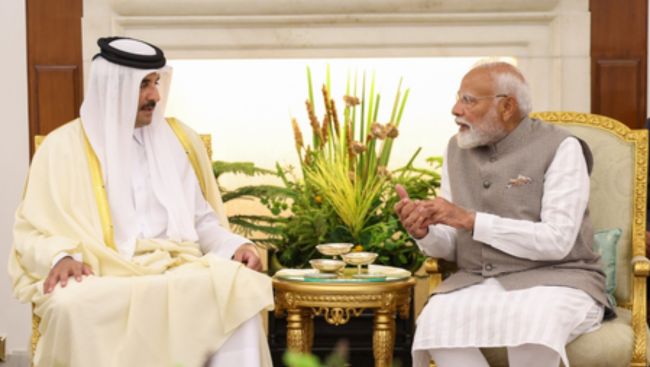
In a strong display of diplomatic support, Prime Minister Narendra Modi held a telephone conversation with the Amir of Qatar, Sheikh Tamim bin Hamad Al Thani, on Thursday to convey warm Eid greetings and firmly reiterate India’s condemnation of the recent attacks on energy infrastructure in the Gulf region.
The phone call comes amid escalating tensions that have threatened global energy supplies and maritime security.
PM Modi, in an X post, reiterated that India stands in solidarity with Qatar and strongly condemned the attacks on the region’s energy infrastructure.
This unequivocal backing follows a blatant Iranian aggression against Qatar’s Ras Laffan Industrial City, the country’s premier liquefied natural gas (LNG) hub, which accounts for nearly 40 per cent of India’s LNG imports.
PM Modi specifically condemned the strikes on the facility, expressing India’s solidarity with Doha in addressing the aggression.
The conversation between the two leaders also touched upon the welfare of the approximately 800,000-strong Indian community residing in Qatar.
PM Modi expressed gratitude to the Qatari leadership for the care and support provided to the Indian community, a gesture warmly acknowledged by the Amir, who praised the robust bilateral relations between the two friendly nations.
The diplomatic outreach is set against a backdrop of extreme volatility in West Asia, particularly concerning the Strait of Hormuz. The strategic waterway, a narrow chokepoint between Iran and Oman, has effectively become a high-risk zone.
Recent escalations have seen Iran follow through on longstanding threats to disrupt the passage, with traffic through the strait plummeting by as much as 97 per cent.
This is critical as the Strait normally sees the transit of around 20 million barrels of crude oil and petroleum products daily, roughly one-fifth of global consumption, along with the majority of Qatar’s LNG exports.
Iran’s Islamic Revolutionary Guard Corps (IRGC) has leveraged its geographic position, deploying fast attack boats, anti-ship missiles, and naval mines, making the narrow shipping lanes, just 3 km wide in either direction, extremely dangerous.
Recent days have seen attacks on at least 16 commercial vessels, including oil tankers, leading to casualties and forcing many operators to abandon the route.
PM Modi emphasised India’s stance on this issue, stating that “We stand for safe and free navigation through the Strait of Hormuz.”
PM Modi’s phone call to the Qatari Amir also aligns with a growing regional consensus against the recent spate of Iranian attacks.
On Thursday, foreign ministers from a dozen Arab and Islamic nations convened in Riyadh for a Saudi-hosted consultative meeting. The gathering included top diplomats from Qatar, the United Arab Emirates, Kuwait, Bahrain, Egypt, Jordan, Turkiye, and Pakistan.
In a strongly worded joint statement issued after the meeting, the ministers condemned what they described as deliberate Iranian attacks using ballistic missiles and drones targeting residential areas and civilian infrastructure.
This includes strikes on oil facilities, desalination plants, and airports.
The ministers stressed that such attacks cannot be justified under any circumstances and affirmed the right of states to self-defence under Article 51 of the UN Charter.
They further called on Iran to halt its attacks and to refrain from actions that threaten international navigation in the Strait of Hormuz, urging Tehran to comply with UN Security Council Resolution 2817.
The statement from the Arab and Islamic foreign ministers also made it clear that the future of relations with Iran hinges on Tehran’s respect for the sovereignty of nations and the principles of good neighbourliness.
This unified stance from the region, coupled with India's vocal condemnation, underscores the international isolation of these attacks and the collective demand for de-escalation to ensure global energy security and stability.
Picture Courtesy: IANS