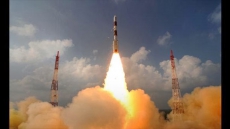
India on Wednesday placed its fifth navigation satellite in the earth's lower orbit after a textbook-launch from the rocket port here.
With this launch, India moves closer to joining a select group of nations having their own satellite-based navigation systems to provide accurate position information services to users across the country and the region, extending approximately 1,500 km around India.
"We have begun the new year with a successful launch and a precise injection of the fifth navigational satellite in the intended orbit," Indian Space Research Organisation (ISRO) chairman A.S. Kiran Kumar said from the mission control centre 20 minutes after the PSLV rocket carrying the satellite blasted off at 9:31 a.m.
The 44-metre-high polar satellite launch vehicle (PSLV-C31), weighing 320 tonnes and carrying the 1,425-kg Indian Regional Navigation Satellite System (IRNSS-1E), soared into a cloudy sky, leaving behind a column of dense orange flame and a huge cloud of fumes at the second launch pad of the Satish Dhawan space centre on the sea coast here, about 80 km north-east of Chennai.
"The spacecraft's solar panels were deployed soon after its separation from the rocket and injection in the intended orbit. The satellite's health is normal," the Indian space agency's satellite director M. Annadurai said.
President Pranab Mukherjee and Prime Minister Narendra Modi congratulated the ISRO scientists on the successful launch.
"Heartiest congratulations to the ISRO team on the successful launch of navigation satellite IRNSS-1E," the president said in his message.
"Congratulating the dynamism and determination of ISRO and our scientists on the successful launch of PSLV-C31 and putting IRNSS-1E in orbit precisely," Modi tweeted.
The Indian Regional Navigation Satellite System (IRNSS) comprises a constellation of seven satellites of which IRNSS-1A, IRNSS-1B, IRNSS-1C, IRNSS-1D and IRNSS-1E have been put into orbit so far.
"We are preparing to launch the sixth and seventh navigation satellites in the next two months to complete the constellation of seven satellites and have our own system," a beaming Annadurai told IANS later.
At the mission control centre, space scientists remained glued to their computer screens to watch the rocket escape the earth's gravitational pull.
After 19 minutes and 20 seconds into the flight, the rocket placed the satellite into sub-geosynchronous orbit at an altitude of 503 km above the earth.
The space agency's mission control facility at Hassan in Karnataka, about 180 km from Bengaluru, took control to manage the satellite's orbit and fire onboard motors till it is placed in its slotted orbit.
"We have a long way to go, as we have two more satellites in this constellation, which we intend to launch in the next couple of months," Kiran Kumar said.
The space agency's officials earlier told IANS that IRNSS had been proved a success by the signals received from the four navigation satellites already orbiting the earth.
"The system will provide two types of services -- standard positioning services to all users and restricted services to strategic users," Annadurai added.
The former is provided to all users while the later is an encrypted service for authorised users.
The IRNSS system also includes two satellites that would remain on ground as stand-bys.
Each satellite costs Rs.150 crore while the PSLV-XL rocket costs Rs.130 crore. The seven rockets involve an outlay of Rs.910 crore.
The space officials said the Indian system was unique as it consisted of seven navigation satellites while other similar systems in the world have more than 20 satellites.
Unlike other systems which are global, the Indian system is regional. The ISRO is silent on the system's strategic applications.
The IRNSS is similar to the global positioning system (GPS) of the US (24 satellites), Glonass of Russia, Galileo of Europe and China's Beidou.
While GPS and Glonass are fully functional global systems, the Chinese and the Japanese systems are offering regional coverage. Europe's Galileo is yet to be made operational.