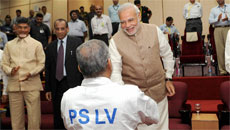
India successfully launched its INSAT-3DR advanced weather satellite in copy-book style on Thursday evening using its heavy geosynchronous satellite launch vehicle (GSLV-F05) rocket.
Around 17 minutes after lift-off from the Satish Dhawan Space Centre here at 4.50 p.m., the GSLV rocket slung the 2,211 kg satellite into a geosynchronous transfer orbit (GTO), from where it would be guided to its final geostationary orbit. The launch was delayed by 40 minutes as the fuelling of the third stage of the rocket took longer than expected.
With the launch of INSAT-3DR, the Indian space agency has successfully launched three satellites weighing over two tonnes of the six satellites weighing over two tonnes it had flown in a GSLV rocket.
The successful flight of the GSLV rocket on Thursday gives the Indian space programme a much-needed boost as getting the third stage cryogenic engine right is important for its future space programmes as well as for commercial launches.
Indian space scientists have spent around two decades and around Rs 500 crore ($75 million)in conceiving and developing the cryogenic technology.
Indian Space Research Organisation (ISRO) scientists at the mission control centre were visibly happy. They slapped each other on the back and hugged each other once the rocket ejected the satellite, which can also aid in search and rescue (SAR) missions, into its intended orbit.
"Today we reached one more landmark, successfully putting the weather monitoring satellite into orbit," ISRO's Chairman A.S. Kiran Kumar said.

According to ISRO, the satellite incorporates technological improvements like: (a) imaging in middle infrared band to provide nighttime pictures of low clouds and fog, (b) imaging in two thermal infrared bands for better estimating sea surface temperature and (c) higher spatial resolution in the visible and thermal infrared bands.
Also on board the INSAT-3DR is a satellite-aided search and rescue transponder that operates at 406.05 MHz to pick up and relay signals from distress beacons of maritime, aviation and land based users to the Indian Mission Control Centre located at Bengaluru.
According to ISRO, the major users of this technology in India are the defence services, the Coast Guard, the Airports Authority of India, the Directorate General of Shipping and fishermen.
The Indian alert service region includes a large part of the Indian Ocean region covering India, Bangladesh, Bhutan, the Maldives, Nepal, Seychelles, Sri Lanka and Tanzania.
The INSAT-3DR also carries a data relay transponder (DRT) for receiving meteorological, hydrological and oceanographic data from remote uninhabited locations in the coverage area from platforms like automatic weather stations, automatic rain gauges and agro met stations.
The satellite's life expectancy is 10 years.
The GSLV is a three stage rocket. The first stage is fired by solid fuel and its four strap-on motors by liquid fuel. The second powered by liquid fuel and the third is the ISRO-developed cryogenic engine that is more efficient as it provides more thrust for every kilogram of propellant burnt.
ISRO is perfecting the crucial cryogenic engine technology to save precious foreign exchange by launching heavier satellites on its own.
ISRO currently relies on the European Space Agency's Ariane rocket to launch its heavy communication satellites.
India pays around Rs 500 crore ($75 million) as the launch fee for sending up a 3.5 tonne communication satellite. The satellite cost is separate.
ISRO can now launch satellites weighing around 2-2.5 tonnes till such time it readies an advanced GSLV variant -- GSLV-Mark III -- that can lug satellites weighing around four tonnes.
The year-end is expected to see the launch from here of the GSLV-Mk-III with the GSAT-19 communication satellite weighing around 3.2 tonnes -- the heaviest to be lifted by an Indian rocket.
CHINA FAILS TO PUT A HIGH-TECH SATELLITE INTO ORBIT: REPORT
In a rare setback, China today failed to put one of the most advanced satellites into orbit resulting in the loss of the satellite, a media report said.

A Long March 4C rocket blasted off from the Taiyuan Satellite Launch Centre in Shanxi but aihangtian.com, a website run by Chinese professional astronautic experts and space enthusiasts, said it failed to insert its payload, the Gaofen-10 satellite into its designated orbit, in what would be the first such failure since 2013.
There is no official announcement about it so far.
The police department of neighbouring Shaanxi province also posted photos on its social media account of a search and recovery mission for debris, in which the launch was dubbed a "failure", the Hong Kong-based South China Morning Post reported.
While the entry was later removed from Weibo, it posted the debris of the rocket posted by the police.
The rocket was put into orbit the Gaofen satellite which is part of series designed to give China a global network of earth observation satellites with high-definition, all-weather, 24-hour intelligence gathering capabilities for military and civilian users by 2020.
The network is designed to be able to monitor any spot on earth.
While China has been launching numerous satellites including the quantum communication satellite which provides hack-proof communication and prevent wiretapping and intercepts.
This is first time Chinese rocket failed since 2013, the post said.
In December 2013, the launch of an earth observation satellite jointly built by China and Brazil aboard a Long March rocket failed because of a rocket malfunction.
Nonetheless, the Long March series is claimed by the Chinese government to be the world's safest rocket, with nearly 20 launches per year in recent years and a success rate of more than 96 per cent, the Post report said.