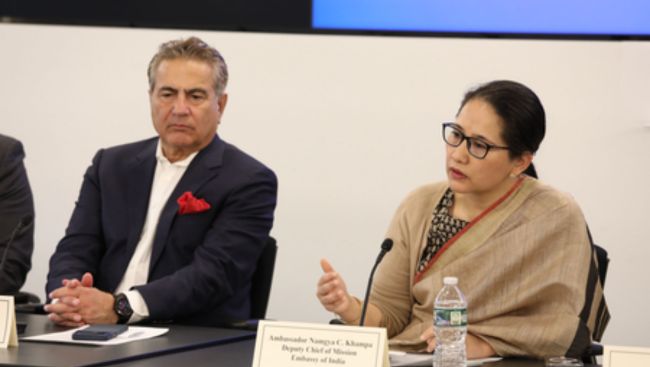
India’s upcoming AI Impact Summit in New Delhi will be anchored around three core themes — people, planet and progress — with the aim of shifting global artificial intelligence discussions from principles to practical outcomes, India’s Deputy Chief of Mission in Washington, Namgya Khampa, said.
Khampa’s remarks came at “US-India Strategic Cooperation on AI,” a discussion organised by Observer Research Foundation America (ORF America), the Special Competitive Studies Project (SCSP), and the Embassy of India, at the US Capitol that brought together policymakers and experts to outline shared priorities ahead of the summit.
Khampa said artificial intelligence was no longer a niche technology but had become the operating context shaping economic competitiveness, geopolitical power and societal outcomes.
She said India’s approach to AI was grounded in its experience with digital public infrastructure, which had demonstrated how inclusive, interoperable and low-cost technology could transform governance at a population scale.
She noted population-scale platforms such as Aadhaar and the unified payments interface had expanded access to public services, finance and identity for more than 1.4 billion Indians.
India, Khampa said, viewed AI not as a standalone solution but as a “force multiplier” layered on top of its digital public infrastructure, making systems “smarter, more responsive, more productive and more accessible,” and helping shift AI “from the abstract to the everyday and from innovation to transformation.”
Khampa said the AI Impact Summit would be the first major global AI summit hosted by a country from the Global South. She said the summit sought to correct imbalances in global AI governance by broadening participation and ownership, rather than by lowering standards.
Outlining the summit’s framework, she said the three themes — people, planet and progress — reflected India’s vision of “AI for all.” AI, she said, must empower individuals rather than marginalise them, be resource-efficient and aligned with sustainability goals, and support equitable economic growth, particularly in healthcare, education, agriculture and public service delivery.
Noting that sharper geopolitics and the weaponisation of technology supply chains had made technological resilience central to national strategy, she pointed to the India-US trust initiative as a mechanism to move cooperation from ideas to concrete projects across research, standards, skilling and next-generation technologies.
India’s linguistic diversity and population-scale digital platforms, she said, offered an unparalleled environment to build inclusive, multilingual AI systems, while the United States brought frontier research, capital and advanced use cases that could be tested in India and scaled globally.
Dhruva Janshankar of ORF America said India was increasingly positioning itself as a bridge between global debates on AI safety and the need for large-scale, real-world deployment, particularly for developing countries.
He said much of the early global AI conversation had been dominated by abstract or existential risks, while countries in the Global South were more focused on whether AI could deliver tangible improvements in healthcare, education, public services and economic opportunity.
Janshankar said many developing countries, despite regional differences, shared common challenges such as limited access to technology, fiscal constraints, and the risk of marginalisation in global rule-setting.
He also warned that global competition in AI deployment was already underway in emerging markets. If democratic countries failed to offer affordable, scalable and trusted AI solutions, he said, others would fill that gap.
Janshankar said deeper US-India cooperation could help deliver interoperable AI platforms aligned with democratic values, while ensuring that developing countries were not locked into technologies that did not reflect their interests.
India will host the AI Impact Summit in New Delhi next month, bringing together governments, industry and civil society to focus on inclusive, development-oriented AI deployment, with particular emphasis on the priorities of the Global South.
Picture Courtesy: IANS