India on Wednesday unveiled its long-awaited civil aviation policy with a roadmap to support 300 million air travellers in five years and steps to make flying affordable and convenient. It also recasts the controversial norms on national carriers flying abroad.
Besides sops to make India a hub for aircraft maintenance, the policy proposes an all-inclusive tariff of Rs 2,500 per ticket for each flying hour to promote regional routes and facilitate more people to travel at lower costs with incentives for airport developers, operators and carriers.
One of the most contentious rules that had split the domestic airlines was the 5/20 norm of five-year operation and a 20-aircraft fleet to qualify to fly overseas. The five-year wait is now done away with, but airlines will need 20 aircraft or fly 20 per cent on domestic routes.
The new policy was approved at a cabinet meeting chaired by Prime Minister Narendra Modi after several years of discussions, following which a revised draft policy was last uploaded by the civil aviation ministry on October 30 last year for comments from stakeholders.
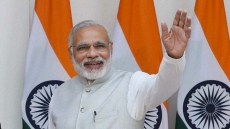
Prime Minister Modi said that the policy will "transform" the aviation sector, enhance "regional connectivity" and "greatly benefit passengers".
"#CivilAviationPolicy gives an impetus to affordability, regional connectivity, safety, infrastructure, which is vital for #TransformingIndia," the prime minister wrote on Twitter.
"The #CivilAviationPolicy approved today by the Cabinet will transform the sector & greatly benefit passengers," Modi added.
Civil Aviation Minister Pusapati Ashok Gajapathi Raju said it was for the first time that India has an integrated civil aviation policy that has been crafted after some 450 responses and talks with all stakeholders -- airlines, airport operators and informal consultations among ministers.
The ambitious policy seeks to make India figure among the three largest aviation hubs in terms of passengers within the next decade from the ninth position now, while promoting the entire chain of aviation infrastructure: from cargo and maintenance to charter services and manufacturing.

Civil Aviation Secretary Rajeev Nayan Choubey said while India built more than 350 airports and airstrips during and after World War II, many of them are inoperational. A new scheme will seek to revive as many as possible as no-frills airports at an investment of Rs.50 crore each.
This will be a a part of the regional connectivity scheme that will kick-off from July, along with a cap in all-inclusive fare of Rs 2,500 per ticket per hour of flying, and viability gap funding for airline operators. Excise duty in such airports will be just 2 per cent on fuel.
"Apart from funding, there will not be any airport charges -- like for landing, parking as also navigation -- to the un-connected airport. The service tax will also be reduced by 90 per cent on the ticket which would make the effective rate come down to 1.2 per cent," Choubey said.
The government also intends to develop India as an MRO (maintenance, repair and overhaul) hub to attract business from foreign airlines with sops such as a service tax concession, customs duty exemption for tools, self-certification for parts and a longer, six-month stay for foreign aircraft to park in India.
"The maintenance, repair and overhaul (MRO) business of Indian carriers is alone around Rs 5,000 crore, 90 per cent of which is currently spent outside India," said the policy document. It seeks to get India this share, than airlines going to Sri Lanka, Singapore, Malaysia and the UAE.
Broadly, the policy dwells on upgrade of airports, regional connectivity, easing of norms for flying abroad, liberalisation of open skies regime, development of cargo hubs, chopper services, attracting investments in maintenance and ground handling and security.
Officials said norms for choppers and how to utilise the excess manpower in terms of pilots will be announced separately. The ground handling policy, which has been criticised for jacking up operational coss has also been recast to allow airlines carry out self-handling.
There will also be three independent ground-handling agencies, including those associated with Air India, at every large airport. The number of such agencies in other airports will be decided by the operator.
As per the data furnished by the Airports Authority of India (AAI), the country had seen 168.89 million domestic and over 54 million international air travellers in 2015-16.

The new norms on flying overseas are expected to benefit at least two new entrants -- Vistara and AirAsia. India currently has 15 scheduled carriers. Three international carriers have stakes in Indian carriers -- Singapore Airlines with the Tatas in Vistara, AirAsia again with the Tatas and Etihad in Jet Airways.
India Inc gave a thumbs up to the policy.
“It would help in stimulating growth and competitiveness of Indian aviation sector when implemented effectively; and would make flying more affordable for domestic flyers and India more accessible to international travellers," said Palash Roy Chowdhury, Co-Chairman of Civil Aviation Committee of Ficci ().
Another leading industry chamber the Associated Chambers of Commerce and Industry of India (Assocham) pointed out that the new policy is a turning point for India’s civil aviation sector, as it frees the operators from the shackles of 5/20 rule for flying overseas.
"The step would surely attract more investment in the aviation which in any case had become quite viable after a sharp correction in the fuel prices," said D.S. Rawat, Secretary General, Assocham.
According to Sharat Dhall, President, Yatra.com elaborated that: "A cap of Rs 1,200 for 30 min flights and Rs 2,500 for 1 hour flights should really drive growth in a hugely under-penetrated domestic air market and catalyse economic growth in tier 2 and tier 3 markets."
Dhiraj Mathur, Partner - Aerospace and Defence, PwC said that the cap on FDI (foreign direct investment) is counter intuitive.
"In an environment in which there is an urgent need for infusing capital into the sector, limiting foreign capital through a cap on FDI is not consistent with the government’s objective of expanding the sector in India," Mathur explained.
Amber Dubey, Partner and Head, Aerospace and Defence, KPMG in India said that the policy has been silent on issues like formation of an independent Civil Aviation Authority (CAA), privatisation of Air India, market-listing of AAI, hive-off of Air Navigation Services (ANS) from AAI.

"Making the first ever integrated aviation policy was tough. The road ahead will be tougher as we go for its implementation in letter and spirit," Dubey said.