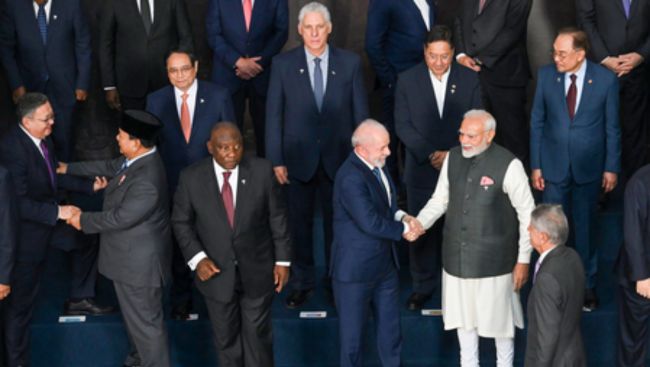
India's 2026 BRICS presidency is expected to test New Delhi’s diplomacy even more than its highly successful presidency of the G20 as BRICS members - including Iran, the UAE and Saudi Arabia - navigate divergent positions amid the escalating conflict in the Middle East. The question, a report highlighted on Thursday, is how India would be able to forge consensus language acceptable to all sides.
Former Foreign Secretary Kanwal Sibal wrote in India Narrative that the "unwanted war" is presenting unwanted disruptions in India's ties with West Asia.
"Our presidency of BRICS this year will test our diplomacy even more than our very successful Presidency of the G20 did. Iran is a member of BRICS, and so are the UAE and Saudi Arabia. How will we be able to build some consensus language that is acceptable to both sides? Russia and China, both permanent members of the Security Council, have diplomatic and economic cards to play that India does not have," the former diplomat wrote.
"India’s relations with the US, which has triggered this war, have a different political complexion than those of Russia and China. We will have to consult closely with Russia, China, Brazil, South Africa, Egypt, and Indonesia to draft a consensus, which we will no doubt do," he added.
He highlighted further that, for India, a prolonged conflict would be most costly.
"Sustained high oil and gas prices would have an impact not only on the economy but also entail social costs. The dynamism of our growing ties with the Gulf countries, where we have vital interests, will be disturbed. The model of growth and development. and the technological future of the Gulf countries, especially the UAE, in partnership with India, will be called into question. India will find it challenging to maintain a balance between our ties with Israel, Iran, the GCC countries, and the US, with each of whom we have compelling interests," wrote Sibal.
Citing Donald Trump's "changing statements", Sibal stated that the US President has no clear strategy for ending the war with Iran that he and Israel have launched. Highlighting that the US has the power to continue striking Iran, he questioned the strategic end behind such actions.
"Trump seems to have calculated initially that he could intimidate the Iranian regime into yielding to his demands on eliminating its nuclear programme, limiting its missile capability, and curbing its destabilising regional role by massively deploying US military forces in West Asia. This show of military strength did not work, much to the publicly expressed surprise of his advisor Steve Witkoff, who wondered why Iran had not buckled under the pressure,” the seasoned Indian diplomat detailed.
“Trump then delivered a major blow by green-lighting the decapitation of the top leadership of Iran: the Supreme Leader along with several members of his family and the senior-most Iranian Generals. The calculation that this would break the back of the clerical regime and a leaderless Iran would collapse has proved to be mistaken,” Sibal wrote in India Narrative.
Emphasising that the war has to end at some point, the former Foreign Secretary said that while Trump seems to be looking for an “off-ramp”, Iran is unwilling to enter negotiations.
“For Iran, this is an existential struggle. It cannot place trust in any peace agreement with Trump because twice now the US has engaged with Iran in negotiations, and twice during their course the US has attacked Iran. The US and Israel have made it clear that they want to get rid of the clerical regime in Iran. For those who hold power in Iran, including the IRGC, this means the US acquiring control over Iran’s resources and foreign policy and Israel exercising unchallenged hegemony over the region in the future with US backing,” he mentioned.
“The stakes are very high on both sides. The US cannot accept defeat, and neither can Iran. The question is who has greater staying power,” he further stated.
Picture Courtesy: IANS