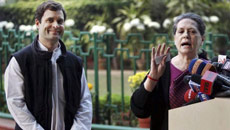
The Congress High Command, which is a pseudonym for party president Sonia Gandhi, must have realized by now that securing a clean chit for the mother-and-son duo in a report on the poll debacle by a servile loyalist will not put an end to constant carping by party members.
Hence, perhaps, the decision by the admirers of Rahul Gandhi, who has borne the brunt of the criticism, to confront the critics head-on. They have asserted that the vice president should be left alone to carry on with his task of changing the Congress into "a process-driven party" with a role for workers and youths "in decision-making".
The intervention has shown the realization on the high command's part that the earlier punitive step of suspending the membership of the critics was no longer sufficient to stop the flow of disparaging remarks.
The final straw was probably senior general secretary Digvijay Singh's observation that Rahul Gandhi should be seen and heard more. Evidently, in an age of video clips and sound bytes, an invisible and inaudible leader is not an asset.
It was apparently in response to this advice that Rahul Gandhi was seen in his constituency last Thursday and heard lambasting Prime Minister Narendra Modi for playing the drums in Japan while prices were rising in India.
It is not impossible that Rahul Gandhi was asked to become visible and audible by his mother, who had also egged him on during his uncharacteristic foray into the well of the Lok Sabha to call for a debate on communalism.
These manoeuvres carry the danger, however, of exacerbating the "tensions", which Rahul Gandhi has admitted exist within the party. There is a possibility, therefore, of the situation becoming worse for the Congress instead of improving.
It is noteworthy that the latest initiatives concerning Rahul Gandhi have come close on the heels of Priyanka Gandhi-Vadra's announcement of her disinclination to play a major role in Congress politics. Before her "retirement", there was a vociferous demand from within the Congress for her to come forward as one of a trio to rescue the party from its present sorry state.
But since the clamour for her was evidently putting Rahul Gandhi in the shade, the decision was taken to push her into the background lest there should be a suspicion of a "palace coup", as Finance Minister Arun Jaitley hinted.
But even if such a coup has been averted, there is still a fear of intra-party dissonance as the face-off between Rahul Ganfhi's supporters and the old guard suggests.
If he continues to be tight-lipped with occasional bursts of energy at a time when the party's principal opponent is known for his voluble forthrightness and clever, even provocative, turns of phrase, then the average Congress worker will not know where to turn to recover his drooping spirits. This is precisely the reason why he preferred Priyanka Vadra, for she is known as an ebullient personality and a fluent speaker.
But eloquence alone is not enough. The Congress leadership, which means Sonia Gandhi and Rahul Gandhi (for the others do not matter), must be a great deal more articulate about the party's policy formulations.
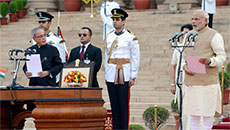
This is all the more necessary because Narendra Modi's line is quite unambiguous. He is intent on taking the country along a right-wing path of economic growth with a focus on industrial development, especially manufacturing, which is evident in his "make in India" call.
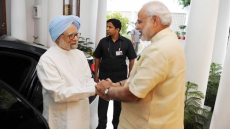
In the process, he is willing to tilt in favour of the industries where green norms are concerned, which were so much of a preoccupation with the previous government that industrial projects were stalled with Manmohan Singh regretting that the licence-permit-control raj was back in the environment ministry.
What are the Congress's views on the subject? Are they still the same as when Rahul Gandhi said that he will be the "foot soldier" of the Niyamgiri Atribals in Delhi as they stopped the extraction of bauxite from the Odisha hills?
Such clarifications are required for they will show how honest the Congress is about its left-of-centre outlook, as highlighted by the functioning of the National Advisory Council (NAC) under Sonia.
To be fair, an element of honesty was displayed by former defence minister A. K. Antony (who wrote the report on the electoral setback) when he acknowledged that the Congress's policies towards the Muslims carried the danger of being misinterpreted as appeasement.
Since these policies include the offer of reservations for Muslims despite its illegality since the constitution does not allow quotas for religious communities, what is the Congress's stance on the merit vs quota debate, especially when sections in the party favour reservations in the private sector?
As Sonia Gandhi's and Rahul Gandhi's criticism of the government on rising prices and the absence of roads and electricity shows, they are focussing on mundane issues and avoiding venturing into ideological fields because they are not sure whether their innate leftist convictions will put off today's aspirational voters even further.
Unless the "multiple voices" in the party, to use Rahul Gandhi's words, help it to find a policy direction, the future is bleak for the Congress.