The jury is still out whether Narendra Modi has ushered in "achhe din" (good days) in the first hundred days of his government. But one thing about which there are hardly two opinions among political analysts of all hues is that after nearly two decades at least we have a stable regime at the centre with a decisive mandate to implement its agenda without any compulsions of coalition politics.
This in itself is no mean achievement in contemporary Indian politics, especially when most political pundits had decreed that the coalition era at the centre has come stay for all times to come in view of the phenomenal rise of the regional satraps.
Winning an absolute majority on his own, of course, does not give a merit certificate to the ruling BJP and that the new dispensation in New Delhi has to be judged on the basis of its performance. But 100 days are hardly any milestone to pause and look back at Modi government's report card.
Narendra Modi has, undoubtedly, given a positive and dynamic push to India in the first 100 days of his premiership. But people have far greater expectations from the new government. At the same time there is a realization that things can't change overnight.
To be fair to the Modi government, probably, it is too early to judge its performance in policy matters. For that people will have to give them some time for the results to be visible. Moreover, there is a lot baggage from the previous regime which the NDA has to unload before proceeding ahead to implement their own agenda.
At the very outset of his first innings in New Delhi, Modi has given some tough but politically correct messages to usher in an era of good governance, accountability and transparency in matters of state.
All those aged 75-and-above political heavyweights, howsoever high and mighty they may be, have been denied berths in the cabinet. It requires courage of conviction to be so ruthless, which Modi has amply demonstrated.
In yet another coldblooded but significant message to check growing "sons and daughters syndrome" in Indian politics, kith and kin of many high-profile BJP leaders have been left out in the cabinet formation. Also, the size of the union cabinet is much smaller than the reasonable limit of 10 percent of the total strength of the two houses of parliament. Apparently, this move too has disappointed many hopefuls in the party and alliance partners alike.
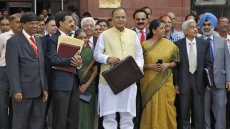
Nonetheless, adequate representation has been given in the union council of ministers to women, Scheduled Tribes, Scheduled Castes, the minorities and backward classes from both houses of parliament maintaining regional balance. The average of age of the ministers is around 60.
Modi has given a roadmap to all his ministers as well as the senior bureaucrats with a timeline for achieving targets keeping in mind three components of his mantra of good governance - transparency, accountability, and implementation. He has introduced a new work culture of punctuality and responsibility among government employees at all levels.
There is no doubt that the Indian economy was in bad shape when Modi took over as prime minister. Perhaps that is why he has sought 60 months to show results.
The markets, especially the benchmark Sensex (over 25,000) and Nifty (over 8,000), have given a roaring welcome to Modi and foreign funds are also pouring in to help the Indian currency get stronger. But lack of investment in infrastructure and social sectors is worrying the Indian youth looking for employment opportunities. Moreover, the results of the measures to check red tape and corruption are yet to be visible.
The current level of inflation and high prices of essential commodities are making common people restless. Modi has warned that, if necessary, he may have to take unpopular measures to revive the stagnant economy.
Some other challenges facing the Modi government include law and order, particularly growing crime against women, Dalits and other weaker sections and incidents of communal violence in some parts of the country.
People have huge expectations from the BJP government and they can't be blamed for this because they have given a decisive mandate to Modi as a symbol of their hopes and aspirations. The government has initiated some effective measures to contain inflation when the wholesale price index touched 6.01 percent. Exports of essential articles have been restricted to do away with supply-side bottlenecks. The government has ordered a crackdown on hoarders to control rising food prices.
Some steps have been initiated to reverse the trend of the rupee depreciating against the dollar. Natural gas price rise has been put on hold. Austerity measures have been introduced for ministers, including a check on their foreign travel and a ban on purchase of new cars. For the first time ministers have been asked to get approval of the Prime Minister's Office for any expenditure above Rs. 1 lakh.
Disinvestment has been encouraged in public sector units by allowing 49 percent FDI in defence sector from the current 26 per cent, subject to the Indian owners exercising management control. But foreign investors want at least a 51 percent stake for joint ventures in defence production.
Also, foreign direct investment of 100 percent in the railways for the first time is intended to raise funds for expansion and modernisation of the country's railway system, the nation's lifeline in many respects. FDI will now be allowed in railway infrastructure segments such as electrification, signalling, high-speed and suburban corridors. It will also be allowed through the Special Purpose Vehicle route to provide last mile connectivity to ports and mines. Further, some railway operations have also been partially opened up to foreign investment.
Estimates suggest that the opening of railways to foreign investors will add 1-1.5 percentage points to the overall GDP growth. China and Japan are keen to invest in the railways sector. As a result of these changes, railways will be removed from the list of prohibited sectors in the consolidated FDI policy.
Modi is also concentrating on social issues like safe drinking water, sanitation, primary health and education for all. The government is also keeping a close watch on the below-average monsoon. The agriculture ministry has been regularly reviewing the monsoon situation as most of Indian agriculture is still dependent on rainfall.
Modi's Rs.113,000 crore Digital India mission, which promises to transform India into a connected knowledge economy offering world class services at the click of a mouse, is likely to be a real game-changer.
Modi's first 100 days have also been laced with heated debate on some controversial issues triggered by the statements of senior RSS & BJP leaders. These include the RSS concept of Hindu Rashtra (Hindu nation), Article 370 of the constitution that gives special status to Kashmir, the so-called saffronisation of education and communal violence in some parts of the country.
These will have to be tackled and cannot be pushed under the carpet or these will erupt into major flashpoints that will impede Modi's modernising and progressive agenda.