A likely meeting between Prime Minster Narendra Modi and his Pakistani counterpart Nawaz Sharif on the sidelines of the SAARC summit has lent added interest to the meeting of the eight-member bloc of South Asian nations to be held in Kathmandu Nov 26-27.
The prime minister leaves Tuesday for Kathmandu to attend the 18th South Asian Association for Regional Cooperation (SAARC) Summit. It will be his second meeting with nearly all the leaders, except for Afghanistan which has a new president in Ashraf Ghani.
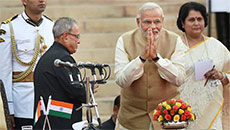
Modi had invited the South Asian leaders for his swearing-in ceremony May 26 as part of his government's outreach to the neighbourhood.
A meeting between Modi and Sharif has not been entirely ruled out during the SAARC summit.
The external affairs ministry spokesperson said the prime minister will go to Kathmandu "with the intention to have a meaningful dialogue with as many SAARC leaders as possible. This would mean, taking into account, all aspects of our relationship. This is a work in progress, in terms of scheduling", he said.
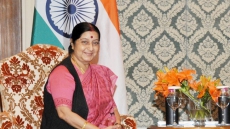
He is being accompanied by External Affairs Minister Sushma Swaraj, National Security Advisor Ajit Doval and Foreign Secretary Sujatha Singh.
During his address at the summit Nov 26, Modi "will lay out his vision of what he sees as regional cooperation in South Asia and India's approach to harnessing the development potential of the region as a whole".
India will focus on enhancement of connectivity and people-to-people contacts during the summit.
Modi has already asked the Indian Space Research Organisation (ISRO) to develop a satellite that will serve all the eight nations.
Nepal Prime Minister Sushil Koirala will host a banquet for all the leaders that evening. On the following day, the leaders will hold a retreat session at Dhulikhel after which they will adopt the Kathmandu Declaration.
Nepal President Ram Baran Yadav will host dinner for all the leaders on the concluding day after which Modi returns.
For Modi, it will be his second visit to Nepal. He had paid a stand-alone bilateral visit to Kathmandu in August, the first such by an Indian prime minister in 17 years.
He had announced a $1 billion Line of Credit and also addressed the Constituent Assembly.
During the forthcoming visit, the prime minister is expected to announce the launch of a Delhi Transport Corporation (DTC) Delhi-Kathmandu bus service, which is expected to boost trade and tourism between the two neighbours.
DTC has a Delhi-Lahore bus service, which was launched by then prime minister Atal Bihari Vajpayee in March 1999.
Modi's earlier schedule had included visits to Lumbini, the birthplace of Lord Buddha, as well as Janakpur and Muktinath, which both Hindus and Buddhists hold as sacred.
However, the visits were called off "due to unavoidable reasons of domestic commitments and pre-scheduled travel within India".
Modi "remains committed to visiting these other places at the earliest opportunity", the external affairs ministry spokesperson said.
The SAARC nations, despite sharing social and cultural affinities, have not been able to prosper as a regional bloc like the European Union, or closer home the 10-member Association of Southeast Asian Nations (ASEAN), have done.
The region is home to almost one-fifth of humanity and two-fifths of the world's poor. The total GDP of the SAARC member states is only three percent of the world total.
South Asian economies are least integrated, with intra-regional trade stagnating at around 5.76 percent of the total trade, compared with 61.83 percent in the European Union.
The bloc is also confronted with major developmental challenges of poverty, inequality, illiteracy, disease, hunger and homelessness.
Afghanistan, Bangladesh, Bhutan, India, the Maldives, Nepal, Pakistan, and Sri Lanka comprise the bloc which was founded by seven states in 1985.