At a recent international conference organised by the Assilah Forum Foundation in the eponymous picture postcard-pretty town in northern Morocco, speakers highlighted the importance of India as a key player in the American "rebalance" in the Asia-Pacific, especially with the worrying rise of China, politically, militarily and economically.
At a lecture in New Delhi to mark 10 years of the Indo-US nuclear deal, then foreign secretary and key negotiator Shyam Saran disclosed that many of the foot-draggers among the powerful Nuclear Supplier Group (NSG) cartel fell in line with the waiver for New Delhi, despite it not being a signatory to the NPT, because, as some of them confided, the exceptionalism happened all "because it was India".
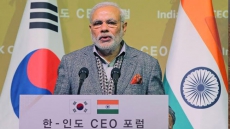
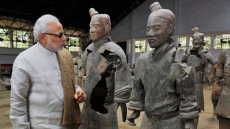
With Prime Minister Narendra Modi in the United Arab Emirates (UAE) for his 26th country visit in just 15 months in power, the question being asked is: Is India set to play a larger role in global affairs? Will India be a "balancing power" or a "leading player"? Will India step in to play a peacemaker role in global hotspots as many countries keep demanding? These and many other questions are sought to be answered by well known strategic analyst and columnist C. Raja Mohan in his latest offering "Modi's World: Expanding India's Sphere of Inlfuence" (HarperCollins).
Raja Mohan says Modi's practice of foreign policy, much to everyone's surprise since he had no previous experience in it, has been "purposeful and consequential" and it was more than just imparting energy - he made 18 foreign visits in the first year of power - but was also about following continuity with some subtle changes in orientation that appeared to lend the policy a more defined and a sharper edge.
According to him, Modi put his personal stamp on four issues:

- discarding defensiveness on global issues, shedding some past certitudes on multilateralism and beginning to alter the way that India looks at global problems;
- overruled long-standing political objections in Delhi to expanding economic cooperation with China, going so far as to to compel the security establishment to liberalise visa rules;
- Bypassing Pakistan to endorse sub-regional cooperation by signing the significant BBIN treaty between India, Nepal, Bhutan and Bangladesh;
- and, overruling opposition within his own party to go ahead with the contentious land boundary agreement with Bangladesh that the previous government lacked the political capital to conclude.
What is Modi's foreign policy vision? Although he himself is yet to articulate it in parliament or elsewhere, two recent policy addresses, one by National Security Adviser Ajit Doval, and the other by Foreign Secretary S. Jaishankar, provide some interesting insights to his and the government's thinking.
Doval made two interesting observations that reflect in many ways the changed thinking of the Indian establishment. One, weak states invite trouble and hence, to demonstrate one is a strong state, one must not hesitate to exercise power. Two, there is little place for morality in international affairs. Nations must take recourse to any means to protect itself, including having to take recourse to capital punishment (in allusion to the debate on the hanging of Yakub Memon) and cannot subjugate the state’s interest to "individual morality" in the larger interest of society.
He also said India was punching below its weight and India should now "improve our weight and punch proportionately".

Jaishanker's speech at Singapore was even more revealing. He talked about changes in India's foreign policy being the "sharpest in the last year" and that "energetic diiplomacy" (by the prime minister) has resulted in India leaving "leaving larger and deeper footprints in the world" and being ready to shoulder "greater global responsibilities".
He made another interesting observation - that India's future lay in being a human resources power, rather than a military or an economic power, and it should be seen by the rest of the world, including the US and China, as an opportunity rather than an investment-risky country. He said the deepening and broadening of ties with the US were among the "key elements of a changing Asian calculus", a point that has been belaboured by the US in recent times.
In a major policy speech at Perth, Australia, in 2012, then Secretary of State Hillary Clinton described India as an important player in the Indo-Pacific region and urged New Delhi to play a larger role in the region's affairs, a suggestion that only got lukewarm response in New Delhi by the government of the day.
At an interaction with editors, then external affairs minister Salman Khurshid in the government of Manmohan Singh made light of these remarks, saying India never saw itself as a "power" in any sense as its foreign policy was largely an instrument to promote national development goals and not for projecting itself to the world in any muscular manner.
That then, as Raja Mohan points out, is where Modi undertook a "definitive reframing of India's foreign policy" in defining a new international identity for India as a "leading power" and has overrulled the "reluctance of its political class to think about the world in strategic terms" and assume "a leadership role".

Modi, true to this character, has dreamed of a Big Power role for India, but the question that remains is India ready yet to play that role, institutionally and structurally, whether it has a political consensus for that strategic leap and whether its forces can be deployed beyond the borders if required to match the expectations of such a role. Some in India may yet be skeptical that things may not have been too well thought out and the delivery may not be able to match such vaunting ambitions.