Even as the Bharatiya Janata Party (BJP) is taking its time to select its chief minister for Maharashtra, Narendra Modi is leaving his distinctive mark on political and other fields.
In politics, the prime minister has brushed aside the earlier by-poll setbacks by his successes in Maharashtra and Haryana. Although the BJP failed to get a majority in the western state, it made a few points which the party probably wanted to make for some time.
One was to cut the Shiv Sena down to size apparently because the BJP, and more specifically Modi, felt that the regional outfit did not deserve the earlier No. 1 position in the state after Bal Thackeray's death.
The calculation probably is that a spell out of power, or in a subservient position in the government, will fatally erode the Sena's base, enabling the BJP to win over the entire Hindutva vote. In the process, Modi again administered a snub to L.K. Advani, who favoured continuing the earlier ties with the Sena.
But it isn't only the party's "senior citizen" who was rebuffed. Even Nitin Gadkari was at the receiving end of a mild reprimand because of the amateurish expressions of support for his claim to be chief minister by some of his followers.
After that, it took the union transport minister less than 24 hours to say that he was not interested in moving to Mumbai, thereby enhancing the prospects of the front-runner, Devendra Fadnavis.
These events point to Modi's penchant for disciplined conduct which is at variance with the lackadaisical way in which Indian political parties tend to function. Modi has also shown that he does not care much for the standard caste- and community-based norms while selecting chief ministers.
This deviation from set patterns was evident from the nomination of Manohar Lal Khattar as Haryana chief minister although he is not a Jat, a dominant community which gave the state its last two chief ministers, Om Prakash Chautala of the Indian National Lok Dal (INLD) and Bhupinder Singh Hooda of the Congress.
Modi is able to adopt such a non-conventional approach because of his awareness that the voters have chosen him for his development agenda and not because of what is known as "identity" politics based on caste and community.
In Maharashtra, for instance, he has been able to negate the Sena's Marathi sub-nationalism to a considerable extent by promising economic growth. It is the same in Haryana, a largely agricultural state which is eager to shed its backward image.
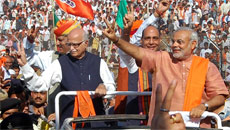
What these developments emphasize is that Modi has become the sole dominant figure in the BJP. Not since Indira Gandhi's unquestioned primacy over the Congress between 1971 and 1977 has there been such a domineering personality in a party at the national level.
As a result, the BJP now depends almost entirely on Modi to win elections with the party president, Amit Shah, being no more than a ground-level organizer. There is little doubt that Modi will again hit the campaign trail when elections are held in Jharkhand and Jammu and Kashmir.
Modi has been helped, of course, by the virtual decimation of his opponents at the national level. The empty political field has given him enough confidence to be in no hurry to come to power in Maharashtra, or even run a minority government in the state if need be, for he is aware that his adversaries are too demoralized by defeat and charges of corruption to pose any threat in the near future.
The confidence has also enabled Modi not to summarily reject the Nationalist Congress Party's (NCP) offer of outside support in Maharashtra although the prime minister had referred to the Congress's former ally as a Naturally Corrupt Party.
It may not amount to overstating the case, therefore, to say that Modi will now begin to eye Tamil Nadu and West Bengal as areas where the BJP can extend its influence with much greater ease than what seemed possible at the time of the general election when the regional parties held their own in the two states.
While Jayalalitha's legal problems and the DMK's declining fortunes under an aging leader and his two squabbling sons cannot but increase the BJP's appeal in Tamil Nadu, West Bengal, too, may look like a low-hanging fruit in view of the scary revelations about the inroads being made by jehadi outfits like the Jamaat-ul-Mujahideen of Bangladesh, with the state government being rather casual about surveillance.
It has to be remembered, however, that the basis of Modi's success is the expectation of economic revival. The hopes are high because the old socialistic disdain for the private sector is dying down as is clear from West Bengal Chief Minister Mamata Banerjee's proposed river cruises for industrialists.
It goes without saying that if there is indeed an economic resurgence, then Modi's one-man show will go from strength to strength. As a result, Mumbai's transformation into a Shanghai, as suggested by the Manmohan Singh government before it lost the plot, may well come true.