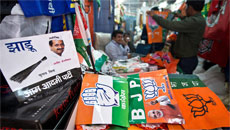
Democracy in India and the Indian elections are a major subject of interest in the Pakistani media and there is a lot of admiration in the media there for Indian democracy, a Pakistani expert said here Tuesday.
Addressing the "Eighth South Asia Dialogue on Role of Media in Promoting Regional Understanding in South Asia", Rasul Baksh Rais, a Pakistani political scientist, said the media is of the opinion that Pakistan must learn a lesson from Indian democracy.
"There is a lot of admiration for Indian democracy in the Pakistani press," Rais said at the Institute of Defence Studies and Analyses (IDSA) here.
Pakistan has been witnessing prolonged mass protests against the government of Prime Minister Nawaz Sharif, demanding its resignation.
Rais also said India's rise regionally and its global ambitions were also a talking point as well as the rise of the ruling Bharatiya Janata Party (BJP), which the media views as an assertion of Hindutva.
On Kashmir, the media feels it is an issue that needs to be settled, but there is also a feeling that the Kashmir issue can be pushed to the backburner and trade and economic ties allowed to blossom between the two neighbours, he said.
On the issue of Afghanistan, where international forces have begun the process of drawdown set for this year-end, there is a sense of "pessimism in the air", which is dominant in the Pakistani media.
"There is pessimism that after the drawdown, Afghanistan may plunge into another civil war and Pakistan should be ready to face such an eventuality," he said.
Afghanistan's former intelligence chief Amrullah Saleh countered Rais' comments on Afghanistan, saying the Pakistani media's reflections on his country were a "reflection of the Pakistani establishment".
To Rais' statement that Pakistan has a "vested interest" in the stability of Afghanistan, Saleh wondered if Pakistan has "a vested interest in our stability, or instability".
"We require the Pakistani media to look at Afghanistan away from relations with India, like what India does. I don't remember Indian officials ever talking about Pakistan when meeting us. Have respect and show it in bilateral relations," Saleh said, sharing the dais with the Pakistani scholar.
Saleh said the media can be a source of building understanding and also creating misunderstanding among people and nations.
Kunda Dixit, editor-publisher of the Nepali Times, said the media, especially electronic media, has no space for major issues like infant mortality, lack of toilets and maternal deaths, but are quick to highlight any provocative content.
He said there should be a filter mechanism to scan the final content of the media as well as an open press.
Syed Badrul Ahsan of the Daily Observer, Dhaka, said the Bangladesh media has lately begun getting quiet political instructions, especially electronic media, saying that "so and so participant or journalist should be removed" from the panel or the beat.
He said while the Bangladesh media was very vocal, he hoped there would be no gagging of the press.
S.D. Muni, distinguished fellow of the IDSA, remarked that there was "very poor" regional integration with regard to the media.
"Neighbours hardly appear as neighbours (in the media)" except as a troubled entity, he said, adding that the media needs to play a greater role in integrating the South Asian neighbours.
Smruti Pattanaik of the IDSA said the South Asian Association for Regional Cooperation (SAARC) Audio Visual Exchange Programme has not materialised so far and there was a need to focus more attention on the neighbourhood.