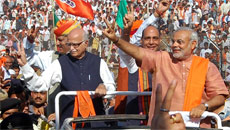
No smart cities, no bullet trains, no spike in employment, no visible improvement in infrastructure, continuing logjam over bills in parliament, carping by in-house critics. Even then, few will say that Narendra Modi will lose if the elections are held in the near future.
The reason is, first, the realisation that one year is not a long enough to give a definitive judgment on the performance of a government, especially when it is emerging from the black hole of the failures of its predecessor.
Secondly, it is also realised that Modi may have been unable to anticipate the mischief-making potential of some of the trouble-makers, including those within the Sangh parivar.
It is the appreciation of these difficulties by the general public which explains why he has passed muster in an opinion poll whereas if the opposition parties are to be believed, his government has failed miserably.

However, it is undeniable that since some of the high expectations with which Modi assumed office have begun to be eroded, he cannot allow the present sense of drift to continue. Unless there is a perceptible upturn in the economy in the next 12 months, the warning bells will begin to ring.
Hindsight suggests that Modi indulged in too much hyperbole during the election campaign. The bombast worked satisfactorily against the dismal backdrop of the virtually non-performing and scam-ridden Manmohan Singh government.
But, Modi's spin doctors evidently did not realise that raising expectations too high - for instance, on the recovery of black money - carries the risk of an equally big disappointment if the hopes are not met.
The risk is all the greater because the Bharatiya Janata Party's (BJP) main base of support at present is the notoriously impatient middle class which believes in quick results.
It was this class which gave the Congress 200-plus seats in 2009 on the basis of high growth rates (although the party's 'socialists' ascribed the good showing to its populism) and then brought it down with a crash to 44 seats when the growth rates tumbled.
The same fate can await Modi unless he pushes the economic reforms with much greater vigour than at present.
As may be expected, Modi's tenure has been marked by a mixture of good and bad luck. Even as he benefitted from the falling oil prices and low inflation, unseasonal rain aggravated the distress of farmers.
But, in political terms, the government has been a victim of what can be deemed an exceptional case of misfortune since its principal opponent, the Congress, has decided to adopt an unabashedly cussed attitude.
As much is evident from the virtual u-turn it has taken on its own economic agenda, introduced in 1991, by following what finance minister Arun Jaitley has called an anti-growth line which, he says, is to the "left of Marx".

As a result, crucial bills such as the Goods and Services Tax (GST) have been held up. But, the worst obstructionism engineered by the Congress relates to the land acquisition law, which constitutes a key feature of the government's development blueprint.
Unless the law is amended, the government will be unable to implement its "make in India" plans which aim at making the country a manufacturing hub.
However, it is not the Congress alone which is to blame for the stalemate. No less guilty are saffron outfits like the protectionist Swadeshi Jagran Manch (SJM) and the anti-reforms Bharatiya Mazdoor Sangh (BMS).
Modi, therefore, is battling not only the anti-development groups cutting across party lines, but also a widely prevalent mindset which is deeply suspicious of the private sector and pro-market policies.
Arguably, he has been unable to gauge the intensity of the opposition to capitalist endeavours even within the saffron camp though he is one of its key members.
The reason perhaps is that he never pushed this line as energetically as he is now trying to do on a national scale. If his efforts in this direction in Gujarat were not opposed as stoutly as the SJM, the BMS and the Bharatiya Kisan Sangh (BKS) are doing now, it was because the pro-business policies were confined to a state.
Modi's miscalculation has been that he did not prepare these groups about what he intends to do on an all-India scale.
It is only belatedly that he seems to have sought the help of the Rashtriya Swayamsevak Sangh (RSS) to tame the nay-sayers.
Earlier, the RSS had backed off on the Ram temple issue, but had advised the BJP to listen to the saffron organisations on the reforms.

The intensification of the anti-Modi campaign by the Congress has apparently left the government with no option but to ask the Sangh parivar's mentor to stand by its side on the land issue.
Whatever the impact of the interventions by the RSS, the Agovernment doesn't have much time to lose to fulfil the expectations - "probably unrealistic", as Reserve Bank governor, Raghuram Rajan has said - of those who voted for Modi in large numbers in the hope that he will bring about India's economic recovery.