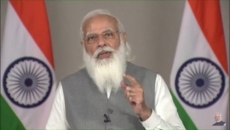
NEW DELHI (AP) — India’s Prime Minister Narendra Modi, who claimed victory for his alliance in an election seen as a referendum on his decade in power, is a popular but polarizing leader who has presided over a fast-growing economy while advancing Hindu nationalism.
Modi, 73, is only the second Indian prime minister to win a third straight term.
People have placed their faith in NDA, for a third consecutive time! This is a historical feat in India’s history.
— Narendra Modi (@narendramodi) June 4, 2024
I bow to the Janata Janardan for this affection and assure them that we will continue the good work done in the last decade to keep fulfilling the aspirations of…
Met our valued NDA partners. Ours is an alliance that will further national progress and fulfil regional aspirations. We will serve the 140 crore people of India and work towards building a Viksit Bharat. pic.twitter.com/ENo9b5ye4J
— Narendra Modi (@narendramodi) June 5, 2024
His Hindu nationalist Bharatiya Janata Party failed to secure a majority on its own — as it did in 2014 and 2019 — after facing a stronger than expected challenge from the opposition. But together with other parties in his National Democratic Alliance, his bloc won enough seats for a slim parliamentary majority and to form his third consecutive government, Election Commission data showed Tuesday.
To supporters, Modi is a larger-than-life figure who has improved India’s standing in the world, helped make its economy the world’s fifth-largest, and streamlined the country’s vast welfare program, which serves around 60% of the population. To some, he may even be more than human.
Congratulations to Prime Minister Narendra Modi and the National Democratic Alliance on their victory, and the nearly 650 million voters in this historic election.
— President Biden (@POTUS) June 5, 2024
The friendship between our nations is only growing as we unlock a shared future of unlimited potential.
India has concluded the world's largest elections! Congratulations @NarendraModi, my dear friend. Together we will continue strenghtening the strategic partnership that unites India and France. pic.twitter.com/NXd4TGnuyO
— Emmanuel Macron (@EmmanuelMacron) June 5, 2024
My warmest congratulations @narendramodi. Committed to continue working w you to further reinforce the Cyprus-India strategic partnership, based on deep-rooted ties, shared interests and the rules-based international order, for the mutual benefit of our two countries and peoples.
— NikosChristodoulides (@Christodulides) June 5, 2024
On behalf of the Government and the People of the United Republic of Tanzania, I extend my heartfelt congratulations to His Excellency @narendramodi on being re-elected as the Prime Minister of the Republic of India. I am looking forward to continue working with you in… pic.twitter.com/kbPYjJ3sG0
— Samia Suluhu (@SuluhuSamia) June 5, 2024
Today I spoke to @narendramodi to congratulate him on his election victory.
— Rishi Sunak (@RishiSunak) June 5, 2024
The UK and India share the closest of friendships, and together that friendship will continue to thrive.
ब्रिटेन और भारत के बीच करीबी मित्रता है, और साथ मिलकर यह मित्रता आगे बढ़ती रहेगी।
🇬🇧🇮🇳
But to critics, he’s a cult leader who has eroded India’s democracy and advanced divisive politics targeting the Muslimswho make up 14% of the country’s population. They say he has also increasingly wielded strong-arm tactics to subdue political opponents, squeeze independent media and quash dissent.
Modi’s government has rejected such accusations and says democracy is flourishing.
Political analysts say Modi’s victory was driven by social welfare programs that provided benefits from food to housing, and the strident Hindu nationalism that has consolidated a majority of Hindu votes for his party. Hindus make up 80% of India’s population.
The economy is growing by 7% and more than 500 million Indians have opened bank accounts during Modi's tenure, but that growth hasn't created enough jobs, and inequality has worsened under his rule, according to some economists.
Modi began his election campaign two months ago by promising to turn India into a developed country by 2047 and focused on highlighting his administration's welfare policies and a robust digital infrastructure that have benefited millions of Indians.
But as the campaign progressed, he increasingly resorted to anti-Muslim rhetoric, calling them “infiltrators" and making references to a Hindu nationalist claim that Muslims were overtaking the Hindu population by having more children. Modi also accused the opposition of pandering to the minority community.
Conspicous piety has long been a centerpiece of Modi's brand, but he's also begun suggesting that he was chosen by God.
In a TV interview during the campaign, he said “When my mother was alive, I used to believe that I was born biologically. After she passed away, upon reflecting on all my experiences, I was convinced that God had sent me.”
In January, he delivered on a longstanding Hindu nationalist ambition by leading the opening of a controversial temple on the site of a razed mosque.
After campaigning ended last week, Modi went to a Hindu spiritual site for a televised 45-hour meditation retreat. Most Indian TV channels spent hours showing the event.
Born in 1950 to a lower-caste family in western Gujarat state, as a young boy Modi joined the Rashtriya Swayamsevak Sangh, a paramilitary, right-wing group which has long been accused of stoking hatred against Muslims. RSS is the ideological parent of Modi's BJP.
The tea seller's son got his first big political break in 2001, becoming chief minister of his home state of Gujarat. A few months in, anti-Muslim riots ripped through the region, killing at least 1,000 people. There were suspicions that Modi quietly supported the riots, but he has denied the allegations.
In 2005, the U.S. revoked Modi’s visa, citing concerns that he did not act to stop the communal violence. An investigation approved by the Indian Supreme Court later absolved Modi, but the stain of the dark moment has lingered.
Thirteen years later, Modi led his Hindu nationalist party to a spectacular victory in the 2014 national elections after promising sweeping reforms to jumpstart India’s flagging economy.
But Modi's critics and opponents say his Hindu-first politics have bred intolerance, hate speech and brazen attacks against the country’s minorities, especially Muslims.
Months after securing a second term in 2019, his government revoked the special status of disputed Kashmir, the country’s only Muslim-majority state, and split it into two federally governed territories. His government passed a law that grants citizenship to religious minorities from Muslim countries in the region but excludes Muslims.
Decision like these have made Modi hugely popular among his diehard supporters who hail him as the champion of the Hindu majority and see India emerging as a Hindu majoritarian state.
Modi has spent his political life capitalizing on religious tensions for political gain, said Christophe Jaffrelot, a political scientist and expert on Modi and the Hindu right. During his time as a state leader, he pioneered a embrace of Hindu nationalism unlike anything seen before in Indian politics.
“That style has remained. It was invented in Gujarat and today it is a national brand," Jaffrelot said.