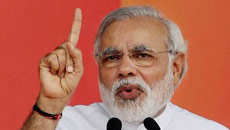
Perhaps the most important part of Prime Minister Narendra Modi's Independence Day speech from the ramparts of New Delhi's Red Fort was his call for a 10-year moratorium on caste-based and communal violence.
As it follows President Pranab Mukherjee's condemnation of the "poison-drips" of bigotry in his broadcast on the eve of Independence Day, it is evident that the government is focussing on the rising communal temperature, particularly in Uttar Pradesh, which has been discussed in parliament.
The emphasis is understandable because no development, which is Modi's primary objective, can take place unless there is social peace. However, the point to ponder is how far the government can go to check this disquieting trend, especially because elements associated with the saffron brotherhood are involved in fomenting tension.
The government may crack down on its opponents who whip up communal feelings, but will the saffronites heed Modi's counsel of restraint? And, what will be the government's response if they don't?
Among those who has long been an offender in this respect is the saffron-robed Bharatiya Janata Party (BJP) MP, Yogi Adityanath, who said during the debate on communal violence that Hindus who feel threatened must "fight back".
Considering that the RSS and its affiliated organizations used the recent occasion of rakhi, or the custom of a sister tying a thread on a brother's wrist, to mobilize Hindus to prevent any of their sisters being courted by Muslim young men, it is not difficult to understand what the idea of fighting back means in the saffron lexicon.
There have also been others from the Hindutva camp whose recent comments have been deemed provocative. Among these is the Rashtriya Swayamsevak Sangh (RSS) chief, Mohan Bhagwat's observation that all Indians are Hindus in a cultural sense irrespective of their religion. Clearly, a moratorium cannot be effective if such poison drips continue.
This is not the only issue on which the prime minister faces a challenge to his authority. There is little doubt that his idea of turning India into a manufacturing hub for the world's industrialists will run into opposition not only from the communist parties and the Leftists in the Congress, but also from the saffron trade union and farmer's outfits such as the Bharatiya Mazdoor Sangh (BMS) and the Bharatiya Kisan Sangh (BKS).
While the BMS has been objecting to the government's feelers on allowing foreign investment and tweaking the labour laws, the BKS is against any amendment of the land acquisition law which was passed by the previous Congress-led government and which is regarded by the corporate sector as a serious obstacle to acquiring land for setting up factories. Not surprisingly, the BKS move has been applauded by the Congress.
On the counts of foreign investment, labour laws and land acquisition, therefore, the Modi government will have to fight on two fronts - against its own saffron camp as well as the left-leaning opposition, which includes virtually all the parties, except perhaps the Biju Janata Dal (BJD) and the Nationalist Congress Party (NCP).
Arguably, Modi can choose to ignore the nay-sayers among the opposition parties in view of the BJP's majority in the Lok Sabha, but his mettle will be tested on how he deals with the critics on his own side.
The magnitude of his task can be gauged from the fact that he will be challenging the fundamental precepts of his internal opponents - the theocratic mindset of the Hindu supremacists and the preference for an autarkic system by the economic fundamentalists.
What is more, he doesn't have time on his hands. Having come to power on the promise of ushering in 'acchhe din' or good days, the prime minister cannot take months, let alone years, to show that he means business.
Even if there is considerable headway in the implementation of his other promises - toilets, model villages, insurance for the poor, et al - the focus will always be on the lowering of communal tension and the inflow of foreign funds. Modi's success or failure will be judged solely on these two points even if "digital India" takes shape and the skewed sex ratio is rectified.
True, the saffron camp cannot afford to be hasty or intransigent. The single-party majority which the BJP has achieved was beyond its wildest dreams. Moreover, there is little doubt that Modi was behind the upsurge of popular support even if the RSS chief has sought to downplay his importance by saying that the party and its leaders were there earlier, too, but it is the people's desire for change which is responsible for the BJP's success.
Even if this not-so-subtle hint aimed at negating Modi's role in the victory suggests that the RSS will offer stiff resistance to any attempt by the prime minister to moderate the pro-Hindu agenda of the saffron warriors, it is unlikely that the latter will seriously endanger the government.
As is not uncommon in politics, the coming days will see a game of bluff between Modi and his home-grown critics, in which those who will be able to hold their nerves will win