It has been almost two months since Narendra Modi took charge as India's prime minister, but the new government is yet to spell out its media and information policy - except by default.
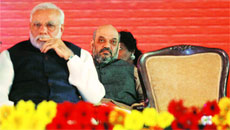
All that journalists are able to surmise - in the absence of any official articulation - is that the Modi government wants to keep members of the fourth estate at an arm's length and feed them information crumbs - only when and what it wants to.
Departing from the convention of naming a media adviser, one of the first acts of any new prime minister in a democracy, Modi has appointed 70-year-old veteran aide, Jagdish Thakkar, as only a Public Relations Officer (PRO), an indication by itself that Modi did not feel the need to have "media advice".
Thakkar, a PRO during Modi's chief ministership in Gujarat and who is familiar with Modi's working style, is increasingly becoming infamous in media circles for not answering calls and, simply, just not being available.
When a group of journalists cornered him at Parliament House recently, Thakkar gave no assurances and said he would only give them what he was asked to give - nothing more.
He also made no promise of answering journalists' calls or queries, a standard practice of a media or press adviser and part of his job profile.
Modi's council of ministers also believe in evading the media - even those who were earlier friendly with the media and loved chatting with them.
Any journalist seeking an interview with External Affairs Minister Sushma Swaraj, who was known to be media-savvy and always available for a juicy anti-government byte as Leader of Opposition in the Lok Sabha, now gets a firm "no" in abrupt and unlikely response.
It is widely known that the Bharatiya Janata Party (BJP) ministers have been told "not to speak to the media" unless an official line about the government's position is to be announced.
It was only after he presented his maiden budget July 10 that the otherwise media savvy Finance Minister Arun Jaitley gave interviews, but only to a select few.
Only Law Minister Ravi Shankar Prasad and Information and Broadcasting Minister Prakash Javadekar, both former party spokesmen, are the ones who are seen on television and sometimes quoted in print.
Senior bureaucrats, who under the previous UPA regime were welcoming to scribes, have been issued a gag order and asked not to "entertain" the media.
"I am personally against such an order but cannot do much about it," an official in the urban development ministry told IANS, while making sure he was not going to be named.
In fact, in some ministries, if a mediaperson is seen near a minister's office, in Parliament House, or in the ministries, they are rounded up and packed off.
This was not so during the Manmohan Singh regime.
Ministers and secretaries were ready to talk to mediapersons, give bytes and interviews and, in the last months, even against their own government.
For the media, all this is new. From being treated as VIPs, mediapersons now suddenly feel they are "pariahs" in the new establishment.
With tweets, Facebook and official releases being almost the sole "source" for news stories, many journalists openly share that getting an "exclusive" would now become difficult. It also means that everyone will get the news at the same time.
"No minister is willing to talk. Even taking an appointment to meet the secretary has become extremely difficult. These are not good signs," a seasoned journalist who did not wish to be identified told IANS.
Human Resource Development (HRD) Minister Smriti Irani, who was caught in a controversy over her educational qualification, has been meeting journalists in informal groups. On one such occasion, she pulled them up for writing stories that projected her negatively.
Like her, many of her cabinet colleagues are yet to call a formal press conference to spell out policies and plans for their ministries.
Journalist and commentator Swapan Dasgupta, however, feels it is a "media impression that the council of ministers is avoiding them".
"It is in any case not a public issue. It's a media issue," Dasgupta, known to be close to the ruling establishment, told IANS.
The only formal interaction of the media with any minister was when Javadekar called journalists for dinner July 16. It was also interesting that on the same day and at the same place - India Habitat Centre, but in a different venue - Neelam Kapur, principal director general of the Press Information Bureau (PIB), had also invited senior journalists for dinner.
However, on reaching the venue, journalists were told that the two events had been merged without giving an explanation. But Kapur did look subdued.
Javadekar, when harried by journalists for an interview slot, was evasive. But journalists who hoped he would share information nuggets about the new regime, or the prime minister, were disappointed.
The writing on the wall is clear - avoid the media so that they do not have anything to sensationalise or create controversies.
Modi, who has stopped taking a large press party on his trips abroad and only takes official or demi-official media, may feel that keeping the media at a distance is the best media policy to have.
Veteran journalist Kuldip Nayar, who was the media adviser to late prime minister Lal Bahadur Shastri, feels the Modi administration should follow a clear media policy.
"The channels of communication should be open. The new government should have a transparent media policy. Media wants some kind of connection," Nayar told IANS.