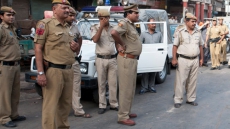
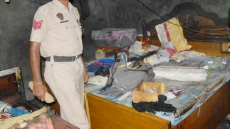
The death of American evangelist John Allen Chau in the North Sentinel Island of the Andamans has brought into focus the existence of tribes who are still in the Neolithic age in this remote Indian archipelago.
It is estimated that the Sentinelese and other Andaman tribes have been cut off from other humans for around 55,000 years.
It was the establishment of a penal colony in the Andaman and Nicobar Islands in the Bay of Bengal by the colonial British rulers in 1858, in the wake of the 1857 uprising, which suddenly exposed them to the vagaries of "modern" forces. The result was an unmitigated disaster.
Without going into a detailed history of the past century-and-a-half, it is necessary to point out that the Great Andamanese Confederation of tribes in these 300-odd islands spread over 8,200 km -- of whom only about 38 are inhabited -- got effectively wiped out though violence, alcohol and lack of immunity to influenza, syphilis and other infectious diseases.
The minuscule numbers lived in Port Blair till they were shifted to Strait Island in 1969, thereby segregating them, but living on government dole.
Similarly the sea-faring, turtle-hunting Onges, though still living in their native Little Andaman, have been settled in a government-created colony at Hut Bay. Though most of the island is a notified reserve, the Onges have stopped hunting and fishing and live on government doles.
Three tribes, the Jarawas, Sentinelese and Shompens have, till recently, shied away from contact with the outside world. The Shompens are shy and retiring, and occasionally come out and receive supplies from the government but are otherwise self-sufficient. They are Mongoloid, unlike the other two who are Negrito.
The Jarawas have received the most attention since government established villages where refugees from East Bengal, Moplah rebels and others have been settled in areas contiguous to Jarawa reserves. For decades there was conflict, with poachers regularly killed by the Jarawas.
Continuous efforts were made to establish friendly relations with the Jarawas -- in 1984 this writer was tasked to lead a team, including anthropologist T.N. Pandit and retired policeman Bakhtawar Singh, who had developed considerable knowledge on the subject, to visit a specific Jarawa area on the day following every full-moon.
Since no effort was made to either bring them out or allow further "legal" encroachment on their land, gradually the Jarawas gave up their hostile attitude. This allowed the Andaman Trunk Road to be built through the Jarawa Reserve in South and Middle Andamans, which unfortunately led to "Jarawa tourism".
Though vehicles move through the Jarawa Reserve in convoys, tourist buses and taxis have been able to entice groups of Jarawas to come out and perform for the tourists in exchange for biscuits and trinkets.
On the positive side, the Jarawas lost their fear of the outside world and their population has gone up, the first time this has happened since they came into contact with the outside world. And, in an incident in 2011, when a group of poachers and their Jarawa guides had an altercation in which a Jarawa got seriously injured, they ran to the nearest police post for help, again a first, which shows how the times have changed.
Over the past few years, the government has engaged with anthropologists and other experts to work on how to manage the transition, including appropriate pedagogical techniques. Many believe that the Jarawas should not be allowed to interact with the outside world, as this would mean denial of agency to the Jarawas, and also would run against the Jarawas own preferred actions.
The Sentinelese are lucky in that they stay on a separate island, 36 km west of South Andaman Island. Their numbers are in the range of 50 to 100 and, though small, they have successfully kept the outside world out.
In 1982, a serious but unplanned attempt was made to contact them physically. There was a silent face-off but one person, the then Superintendent of Police P.V. Sinari, moved closer to them. An arrow was shot to possibly warn him because it was aimed at the ground in front of him but, as he dived, it pierced his life-jacket.
After our successful regular contact, as against previous ad hoc visits, the same team was tasked with attempting something similar with the Sentinelese. We landed but saw nobody, so we withdrew rather than try to go inland.
Subsequently, others also landed, gave gifts, but the tribals made their lack of interest clear; this rejection has been respected by the Indian government. People have been prohibited from entering this area and others who landed have lost their lives.
The American John Allen Chau's misguided attempt ended as expected -- tragically.