Former Indian Navy chief, Admiral D.K. Joshi, who had resigned in February this year after a number of accidents on naval platforms, has dwelt on the background to his unprecedented decision in an extended media interview and in the process shed much needed light on the deeply embedded institutional flaws that plague IndiaÂ’s higher defence management.
In his candid observations, Joshi noted of the stasis in the countryÂ’s defence and military edifice: Â"For more than a decade now recognizing fully that higher management of defence needs reforms, several expert committees have been formed. Virtually all their recommendations have been identical, but vested interests have ensured that the more substantive ones, which bring authority and accountability together, have not been approved. Some peripheral ones have been progressed but nothing substantive.Â"
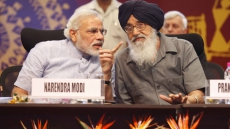
As it happens, Prime Minister Narendra Modi is scheduled to address the top brass of the Indian military, for the first time collectively, after assuming office Friday (Oct 17) and both the nature of the prevailing regional strategic environment and the orientation of IndiaÂ’s principal security interlocutors - China and Pakistan - draw attention to the critical need of of ensuring that IndiaÂ’s composite military capability is of appropriate quality and credibility. However, many inadequacies abound, both within the military and in the delicate pyramid that is subsumed in the rubric of civil-military relations, which have resulted in a less than optimum national military capability.
Admiral Joshi has illuminated the central policy void when he avers: Â"The root cause is this dysfunctional and inefficient business model that we have, wherein professional competence, domain expertise, accountability, responsibility and authority, these all reside in separate silos in different locations. While professional competence, accountability, responsibility is with the service, that is not the case with authority. And by authority I really mean the power to approve something, empowerment to approve something or the other. For example, change of submarine batteries, which are available indigenously or for commencing refits and repairs of ships, aircraft, submarines in Indian yards, the service (navy) does not have that empowerment. That's a broad construct as a background. Where there is authority, there is no accountability. And where there is responsibility, there is no authority.Â"
This mismatch between the different parts of the democratic lattice - namely the elected political leader, the civil servant as representative of the executive and the military as an institution has been India’s Achilles heel since August 1947. India’s first prime minister Jawaharlal Nehru had an innate disdain for the military and this was the beginning of the civil-military divide in the Indian structure of governance. The fear of a military coup was subtly stoked by vested interests in the corridors of power and a naïve military apex allowed the Indian bureaucracy to gradually quarantine them to the cantonment.
Imprudent choices by the Indian service chiefs in the early decades and the debacle of the 1962 war with China resulted in an anomalous division of collective responsibility and empowerment and India has a piquant reality as regards national defence. The three service chiefs have become ‘invisible’ in the country’s higher defence management and this onerous responsibility devolves on the defence secretary, who more often than not may be serving a first tenure in the Ministry of Defence.
This institutional anomaly was noted post the 1999 Kargil war when the NDA government led by then prime minister Atal Bihari Vajpayee set up a group of experts to restructure the higher defence system. Many eminently useful recommendations were made in relation to external and internal security - but alas remained unimplemented. The adage that a diffident Indian political leadership chose to cross the national security chasm in two leaps is valid.
The late K. Subrahmanyam, who headed the Kargil Review Committee, pithily summed up the Alice in Wonderland situation. He wryly noted that that when it comes to national security: "Politicians enjoy power without responsibility, bureaucrats wield power without accountability, and the military assumes responsibility without direction."
The internal health of the Indian military is cause for deep concern and anguish. Morale is low, institutional values and principles are frayed, aspersions of moral turpitude have been cast against the top leadership and the entire General V.K. Singh saga during UPA-II that went all the way to the Supreme Court has led to deep internal fissures within the army.

The material state of the military inventory is frail and whether fighter aircraft, tanks or submarines - it is cannibalization and ‘jugaad’ that is keeping operational readiness at bare minimum levels. In short, Pime Minister Modi and Defence Minister Arun Jaitley have before them the equivalent of cleaning the Manmohan Singh-Antony stables with very limited time and resources.
The gaps in higher defence management and poor civil-military relations have engaged the attention of ModiÂ’s predecessor. A review of Manmohan SinghÂ’s many observations and speeches are instructive. It may be recalled that in late 2013, Singh made his last address to the combined commanders and he dwelt on the need for "urgent and tangible progress in establishing the right structures for higher defence management and the appropriate civil-military balance in decision making that our complex security demandsÂ". He added: "I encourage you to give this the highest professional consideration, harmonise existing differences among the individual services and evolve a blueprint for the future. I can assure you of the most careful consideration of your recommendations by the political leadership.Â"
Modi would be well advised to seek an objective review from all stakeholders in India’s higher defence management and harmonize institutional authority with accountability in a meaningful and effective manner. Many difficult decisions have to be taken if national security is to be put back on track. And if he probes further, he may be appalled to learn that the Indian military is locked in a series of legal wrangles with the Ministry of Defence over pay and pension and that in the current dispensation of Indian governance, officers of the armed forces are no longer on par with Class I civilian cadres and have become a lower ‘caste’.
Can Modi bring both redress and justice to a skewed domain and its subaltern inhabitants? Oct 17 may provide some answers.