With inter-community violence reported from many parts of India in a society increasingly polarised on religious and caste lines, a small town in Uttar Pradesh is setting an extraordinary example where a temple, a mosque, and even a gurdwara, have joined hands to clean a polluted river while bringing their communities together.
About 100 km from the state capital Lucknow is the town named Maholi in district Sitapur. Here lies an old Shiva and a Radha-Krishna temple along with Pragyana Satsang Ashram and a mosque, all at a stone's throw of each other.
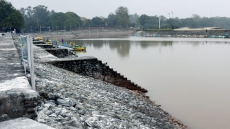
Along the periphery of this amalgamated religious campus, passes a polluted river called Kathina, that merges into the highly polluted Gomti River, a tributary of the mighty but polluted Ganga.
Often used as dumping site by dozens of villages and devotees, the stink from Kathina was increasing daily. The solution -- Ganga-Jamuni tehzeeb (a term used for a fusion of Hindu and Muslim elements) - of Awadh.
"The river belongs to everyone. Hindus use it for 'aachman' (a Hindu ritual for spiritual purification), Muslims use it for 'wazu' or ablution. Due to lack of awareness, people had been dumping solid and bio waste here, and also doing open defecation. The situation was worsening. Only solution was to start cleaning it ourselves," said Swami Vigyananad Saraswati, head of the Pragyana Satsang Ashram, as he inspects the river stretch along with Muhammad Haneef, head of the mosque's managing committee.
Swami said that once the ashram and temple administration began rallying volunteers for the cleaning drive, the mosque also came around to help. Even Maholi's Sikh gurudwara committee came forward and brought along many volunteers from the Sikh community.
"Once the communities came together, number of volunteers multiplied. The initiative has now become a kind of an environment-movement which is being driven by religious fervor and bonding. Watching our efforts, the local administration also offered help, and other unions like traders and Sikh gurudwara committee also joined hand for cleaning the river," Swami told IANS pointing out the potential of possibilities when different communities join hands for good.
Ujagar Singh, a member of the Sikh gurdwara committee, equated the effort in cleaning the river with 'sewa', an important aspect of Sikhism to provide a service to the community.
"Keeping our rivers clean is our duty and we will continue sewa whenever required," he said.
The temple and mosque, near the town's police station, were both built in 1962 by then Inspector Jaikaran Singh. The communal fervor is shared since years. During 'namaaz', the ashram switches off its loudspeakers and on Hindu festivals and special occasions, the mosque committee helps the temple with arrangements.
Still underway, the joint Hindu-Muslim team began cleaning the river from March 14. According to the volunteers, it took three days alone to get the river front cleaned of defecation.
"Many villages do not have toilets and volunteers had to stay here round the clock to stop people from defecating or throwing waste. The work was divided. Muslims volunteers would take over the Muslim majority areas and Hindus would tackle other areas, convincing people to stop pollution further while we clean," Muhammad Haneef told IANS.
The actual cleaning of the river began from March 17, when about 400 volunteers got into the waters, while about 700 of them cleaned the shores.
"Several trolleys of garbage -- that included plastic, polythene, shoes, rubber, animal carcasses, human waste, glass and ceramic waste, and even some old boat wreck -- were taken out of the river.
"Apart from that, several trolleys of water hyacinth, an invasive species of water plant, was removed. It obstructs the flow of the river," Sarvesh Shukla, executive officer of Maholi town told IANS.
Stating that such drive is not possible unless people come together, Shukla said that since 'mandir-masjid' joined hand, it was very easy to convince people to cooperate.
However, with poor garbage management system of small town, Swami and Haneef looked up to the administration for help.
"Few days back, some butchers were taking waste towards the river. We stopped them and there was a heated debate. Soon other elders of the community joined and we did not let them dump the waste into the river," said Haneef, pointing out that stopping people without proper management could be daunting in future.
Swami said that they would need disilting machines to clean the river towards the second phase.
According to Abdul Rauf from the mosque committee, the work is only half done.
"The challenge is to maintain the cleanliness. We could clean only a small stretch of the river. We will rally again and take movement to second phase once we get directions from our elder brother Swami ji," says Rauf.
Nearly one kilometer of the stretch has been cleaned. The volunteers are aiming to clean another kilometer of it.
However, be it river or communal fervor, the challenge, as residents of Maholi find, is consistency of the good.
"There are bad elements everywhere. Few weeks back, a fringe group named Vishwa Hindu Jagran Parishad entered a Muslim-majority area and started hurling abuses. Before they would do more damage, the Hindus of that area came forward and retaliated. The group never returned since," said Shailendra Mishra, a local resident and member of temple committee.
In another incidents, last year in September, when dates of Durgapuja and Muharram clashed, Mishra and Muhammad Rizwan, Haneef's son, took charge.
"All we had to do was keep a few notorious people from both communities at bay. About 5,000 strong Hindu's Devi Shakti procession and about 2,000 strong Muslim Tazia procession of Muharram used the same road at the same time. Not a single untoward incident happened," Haneef said.