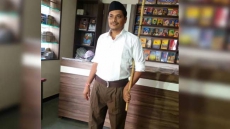
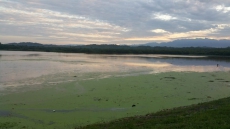
At the Dal Lake in Srinagar, Rizwan Ahmad Bhat stands next to his traditional boat, the shikara named Do Badan Ek Jan (two bodies, one soul), waiting for tourists. Last year this time, the lake was packed with visitors exploring its waters and the views of the surrounding Zabarwan hills.
This summer, the lake and its shores are empty of tourists and the smartly-dressed boatman is upset. "Look at our empty boats," said Bhat, 31. "We have nobody to take a ride."
Half-a-dozen other boatmen, dressed in T-shirts and jeans, stood around, listening to the conversation. They complained that the media is scaring tourists away from Kashmir. "When people watch TV, they think Kashmir is burning and we should not go there," said one of them, and others agreed.
Until July 2016, when young militant leader Burhan Wani's killing sparked a prolonged chain of violence in the Valley, Bhat and other boatmen used to earn Rs 1,000-Rs 1,500 a day. Now they count themselves lucky if they make Rs 400 a day.

It is the same story at Ali Shah Carpets on Saida Kadal Road, seven kilometres off Srinagar's city centre. Unsold rugs and shawls worth crores of rupees are piling up to the dismay of general manager Rafiq Ahmad Shah. "Tourism is a flop this year, so is our production," he said. Orders were given to artisans in winter for summer sales as no one had foreseen the crisis.
Tourism is important for Jammu and Kashmir's economy, contributing eight per cent to the state's gross domestic product. In 2016, the state had recorded 1.3 million tourists. The sector employs over 100,000 people, directly and indirectly, according to approximate industry estimates.
But tourism is also highly sensitive to issues of law and order. In recent months, the national media have been swamped with stories of violence in the Valley and between April and early June, only a few thousand tourists arrived, said tourism officials who did not wish to be named.
The Valley has seen a decline in insurgency-related violence in recent years but there has been a rise in street violence, mostly stone-pelting, as IndiaSpend reported on May 30, 2017. Tour operators and tourism officials argue that this violence is too sporadic and localised to affect travellers.

For tourists, however, any trouble, big or small, is avoidable. Bengaluru resident Badri Raghavan scrapped a long-awaited Kashmir vacation with his wife and three children in June 2017 though the cancellation cost was steep. The family's plans had included a houseboat stint on the Nageen lake in Srinagar and homestay in Sonamarg.
"The tour operator insisted that it is safe but if I have all of seven days in hand for a vacation why would I spend it looking over my shoulders all the time?" said Raghavan.
Tourism figures for the Valley have had a direct link with its law-and-order situation. Kashmir was a strong favourite among national and international tourists until 1988, with over 700,000 arrivals. But in 1989, armed violence began in the Valley and the numbers dropped by 200,000. That year, there were 1,500 violent incidents which included bomb blasts and firing.
In 1990 and 1991, there were 4,211 and 3,780 violent incidents reported, respectively, thereby bringing tourist arrivals to a meager 6,287, a 98 per cent decrease from arrivals since 1989.

In 1995, violence eased in the Valley and in early 1996, assembly elections were conducted after eight years of governor's rule. With a civilian government in place, tourist confidence too returned. In 1998, over 100,000 visitors arrived in Kashmir.
Four years later, India and Pakistan were on the brink of war following the December 13, 2001, attack on Parliament. Assembly elections held in Jammu and Kashmir in September in the same year were also marred by violence. Consequently, tourist inflow declined sharply in 2002, falling to 27,356.
With the start of the India-Pakistan peace process in 2003, and up until 2012, tourist figures climbed steadily to over 1.3 million. In 2015, the numbers fell below one million, but this time because floods had devastated Kashmir in September the previous year, affecting its tourism infrastructure badly.
Hotels fully booked last year now only have 25 per cent occupancy.

Foreign tourists are scarce too, exacerbating tourism woes. Many countries including the US, UK, Germany and France issued travel advisories against Kashmir.
"In a place like Kashmir, tourism inflow is often dependent on peace. But the media reportage about Kashmir is disrupting tourism by creating a false narrative about the situation in Kashmir," Mahmood Ahmad Shah, director-tourism, Kashmir, told IndiaSpend. "In winter itself, TV channels were predicting the start of a bloody summer in March."
The tourism crisis has affected workers more than owners, said Hamid. "Hotel owners at least get tax rebates when the tourism industry suffers, but most workers are either laid off or have their salaries slashed up to more than 50 per cent," he said.
In his late 20s, Shabir Ahmad from Tangmarg (Baramullah) was employed as a service boy by a Srinagar hotel in March 2015. He was asked to either accept a 60% wage cut or leave. "I preferred to stay as I have no other skill," said Ahmad. "Now, I and other employees are just hoping that the tourist inflow to valley improves."