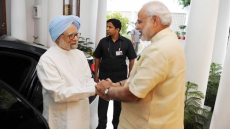
The Narendra Modi government's chief economic advisor, Arvind Subramanian, has said that the rate of poverty reduction from 2005-06 to 2011-12 was the fastest in the country's history. The reason, according to him, was "fast GDP growth".
Rarely before has the Manmohan Singh government received such a handsome compliment on its performance. Although it has been known that an estimated 138 million people were lifted from below the poverty line when the Congress-led United Progressive Alliance (UPA) was in power, Subramanian's praise is the first by someone not associated with the present government.
What is worth examining, however, is why the Congress itself has been reticent about this achievement although the party's senior general secretary, Digvijay Singh, a "loose cannon" in his own words, did acknowledge once that millions of the "poorest of the poor" had been elevated into the lower middle class category because of Manmohan Singh's "right" policies.
Notwithstanding this realization, the Congress has generally been silent about its own government's excellent record in the matter of poverty reduction whereas one would have thought that it would have been trumpeted by the party during and after the election campaign.
The reason for this quietness cannot be unrelated to the party's first family's fear that an acknowledgment of this remarkable feat will, first, turn the former prime minister into a hero at the expense of the crown prince, Rahul Gandhi, and, secondly, that it will underline the success of the reforms process.
The exaltation of the putative "regent" over the heir-apparent was evidently unacceptable to the Congress. After all, the former was only expected to keep the seat warm for the dauphin and not put up an admirable show of governance.
Moreover, the fact that the poverty reduction tapered off from 2011-12 would point to the period when Congress president Sonia Gandhi's aggressive espousal of costly welfare programmes led to the government taking its foot of the accelerator of reforms, as the former finance minister, P. Chidambaram, has said.
It will not be besides the point, therefore, to speculate that if Sonia Gandhi hadn't opted for the various populist measures on the advice of the left-of-centre National Advisory Council headed by her, the high growth rates would have led to further poverty reduction and, perhaps, enabled the UPA to return to power for the third time.
Yet, sadly for the party, the left-leaning ideological inclinations of the first family, and also of a sizable section of its members, led to its worst-ever defeat.
What is strange, however, is that like the proverbial Bourbons of France, the Congress seems to have learnt nothing and forgotten nothing. Not only has it refused to recognize the root cause of its defeat - the folly of junking reforms - the party is now determinedly turning even more to the left in a manner which has made finance minister Arun Jaitley mock it for positioning itself on the "left of Marx".
But the Congress will do well to remind itself that the poverty reduction began within a year of its return to power in 2004 not because it was pursuing socialistic policies, but had restarted the reforms process under its original promoter of 1991, Manmohan Singh.

What is more, the process took off although the communists, who are dead against pro-market policies, were then an ally of the government. As a result, the reforms proceeded haltingly, as when another ally, the DMK, rejected the move to disinvest the Neyvelli Lignite plant in Tamil Nadu, and subsequently when there was firm opposition by the Trinamool Congress and others to allow foreign investment in the retail sector.
Even then, notwithstanding the slow pace of reforms, the lives of the "poorest of the poor" were gradually improving as they moved up into what Modi once called the "neo-middle class" with aspirations to rise further.
The Congress, however, still appears to believe that poverty alleviation is best achieved not through economic growth, but by the distribution of doles and subsidies. Behind this belief is probably the calculation that the largesse will be seen as the bounty of the munificent dynasty which presides over the party's destiny and that gratitude for the benevolence will translate into votes for the Congress.
It is this feudal mindset which baulked at the possibility of Manmohan Singh receiving all the applause for lowering poverty rates, thereby making it nearly impossible for Rahul Gandhi to step into his shoes, as was being speculated at the time.
It is obvious enough that the party cannot but suffer if the interests of a family are put above those of the organization. Its travails will be all the greater if the family members lack the intellectual acuity required at a time of economic change, which is reflected in the expansion of the middle class to accommodate social sections which were earlier outside its fold.
The BJP has understood the change that is taking place, which is why its government has continued to allow foreign investment in the retail sector although the party is against it. This is the difference between a political approach and one based on feudal subservience.
While Modi had the gumption to go against his party, Sitaram Yechury of the Communist Party of India-Marxist (CPI-M) had the honesty to admit that his party erred in opposing the nuclear deal in 2009.
The Congress, however, has only said that its defeat was the result of its failure to communicate its achievements. It is a half-truth because it is still unwilling to do so lest it should hurt Rahul Gandhi's prospects.