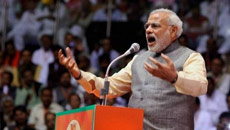
The Narendra Modi government is determined to clean up the country in more ways than one. In an ambitious move, the government intends to junk in one stroke at least 287 obsolete laws and thousands of old appropriation bills which are choking the statute book.
Not only does India have one of the lengthiest constitutions in the world, it also has an extremely bulky statute book with 1,086 central laws and 5,000 state laws, widely blamed on a national propensity to over-legislate to deal with problems - but not following this up with effective implementation.
Attorney General Mukul Rohatgi said that the move, announced last week by Law Minister Ravi Shankar Prasad, whose ministry will in this case be wielding the broom to clean the Augean stables, is an extension of the prime minister's Swachh Bharat programme.
"It is a form of cleaning and removing old garbage. It is in conformity with the PM's Swacch Bharat approach. It has been long pending. A lot of these laws are of 1860; the British have gone and they are no more required. They have no meaning, no place and should be thrown out as one throws out obsolete machinery," Rohatgi told IANS.
Ravi Shankar Prasad had said at a press conference on Sept 29 that, like in Britain, where appropriation bills are destroyed after a few years, India would also only retain the bills that sanction government spending consequent to the passing of a budget for 10 years or so.
Anything older would be repealed, he said. Their numbers alone would be in the hundreds.
If the government succeeds, it will be the culmination of an exercise that began 30 years ago in 1984 when the Law Commission recommended repeal of such laws, including the Bengal Districts Act, 1836, one of the country's two earliest laws.
The present government had moved a bill on Aug 31 to repeal 36 laws in disuse and largely inconsistent with present-day requirements. Now a fresh bill will be moved, in all probability in the November-December winter session of parliament.
The laws likely to exit the statute book include the 178-year-old Bengal Districts Act, 1836, which empowered the then united Bengal government to create new districts. Now new districts are formed by the West Bengal government under its respective revenue codes.

Also to be axed are the Young Persons (Harmful Publications) Act, 1956, that prevents dissemination of publications considered harmful to youngsters up to the age of 21 years. This law is, in any case, inconsonant with several other current laws defining the age of majority.
Another law to go seeks to prevent unfair competition amongst newspapers with the Newspaper (Price and Page) Act, 1956.
Yet another law, the Delhi Hotels (Control of Accommodation) Act, 1949, that will cease to exist allows the government to reserve up to one-fourth of the accommodation available in certain private hotels in Delhi for use by government officials.
There are laws which should have gone off the statute book a long time ago. Legal experts said that some of these laws should have had in-built expiry clauses to spare successive governments the pain of having them
expressly repealed.
The Bangalore Marriages Validating Act, 1936, enacted to validate certain marriages solemnized by priest Walter James McDonald Redwood in Bangalore will also go.
Also on the guillotine list is a 1933 law that prohibited the atrocious practice by parents pledging the labour of the child: Children (Pledging of Labour) Act, 1933.
Such obsolete laws must go, well-known lawyer Kamini Jaiswal said. "They are just crowding the statue book, they are never used," Jaiswal told IANS.
Senior counsel and former additional solicitor general Amarendra Sharan welcomed the move to rid the statute book of useless laws but said that the process should not stop there.
The next logical step should be to "simplify procedural laws and remove obsolete provisions from them. What is the relevance of keeping the Thuggee and Dacoity Suppression Acts, 1836, on the statute book? It might have been of some relevance in the past but now it is inconsequential," Sharan told IANS.
He advocated the need to further press on and simplify "legal language" and "legal procedures" to make the law more accessible to those who need it.
"It is not just a question of having our laws in conformity with the changing world scenario but also meeting the changed local situation. We don't have a society that prevailed 175 years ago. How can laws relevant to a situation 175 years back or even much later be relevant in today's changed conditions?"
The Law Commission had recommended, in its 96th report in 1984, the repeal of a host of laws saying that it was incumbent upon the legislature to weed out those that have become deadwood.
"Every legislature is expected to undertake what may be called the periodical spring-clearing of the corpus of its statute law, in order that deadwood may be removed and citizens may be spared the inconvenience of taking notice of laws which have ceased to bear any relevance to current conditions...," it had said.
The process of weeding out obsolete laws "assumes still greater importance in modern times when statue law is growing in bulk and magnitude", it had said.

Leading legal authors contrast this with the British experience, where laws are rarely written down but conventions are followed more rigidly than laws.
Senior Supreme Court lawyer and former Delhi High Court judge Rupinder Singh Sodhi told IANS: "We are a nation dependent on absolute and inappropriate laws and have governments which are more in business than in doing governance."
Will Modi's broom wield the magic?