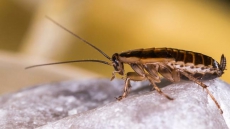
With food shortage expected to become a major problem in the next decades, many experts believe that insects could become a major source of nutrients for people in the future. We already have plenty of insect based recipes and restaurants have begun putting bugs on their menus, but we need an effective way of using them as replacements for staples of our current diet, like wheat.
Well, a couple of Brazilian food scientists have make a breakthrough in that area after successfully turning a species of cockroaches into flour and using it to bake bread.
Andressa Lucas and Lauren Menegon, two engineering students at the Federal University of Rio Grande, in Brazil, have developed a flour made from cockroaches that contains 40% more protein than regular wheat flour and can be used to make all kinds of baked goods. It also contains lots of essential amino acids, as well as amino acids and lipids.
And before you start acting all disgusted, the flour is not made from bugs like tho ones crawling through your kitchen at night, but of a species called Nauphoeta cinerea. They are sourced from a specialized breeder, where they are produced according to the hygiene requirements of the ANVISA, the Brazilian health surveillance agency, and fed exclusively on fruits and vegetables.
"We chose the cockroach because it was the insect that had the highest protein content almost 70 percent. It contains eight of the nine essential amino acids, it has high-quality fatty acids (such as omega-3 and omega-9) and we can use almost 100 percent of it, with very little residue," the two scientists told VICE Munchies.
"Insects are exceptionally effective in converting what they eat in nutritional structures that can be consumed by humans. Since they are rich sources of protein, they can enrich the human diet, especially for people suffering from malnutrition, and their consumption can help reduce the negative environmental impacts of livestock, since it requires less space and generate less pollution, so these factors were enough to convince us to start the research."
The VICE interview doesn't reveal how the two scientists turn the cockroaches in to flour, I think it's fair to assume that the insects are dried and then finely ground into a fine flour-like powder. This then mixed with regular mixed flour to create baked goods like bread with a considerable protein content. Lucas and Menegon conducted a study and found that a bread containing just 10% cockroach flour presented a protein increase of 49.16 percent, when compared to bread made only with wheat flour.
Interestingly, everyone who tasted the bread made with a small part cockroach flour said that they detected almost no difference in taste, and when combined with more ingredients, like cereal bars or cakes, this change in taste is even harder to detect.
However, Andressa Lucas and Lauren Menegon have also found that most people are still not comfortable with the idea of insects as a food source. When they asked people to sample their special bread and told them it contained cockroach flour, the majority of them chose not to taste it. The two scientist hope that people's perception will change with time, and are currently experimenting with other insects, like crickets and beetles, which hopefully won't put people off as much as cockroaches.
"The UN estimates that by 2050 there will be no land area available for food production to supply the entire population of the world. In the case of insect breeding, smaller spaces are used and it is is an extremely ecological production because much less water is used and the insects produce fewer gases [contributing] to the greenhouse effect than the cattle," the two scientists said.
"In the end of the process, we are also able to use the insect in its totality, which doesn't happen with cattle because many parts are not used for human consumption. Today this is not yet a reality, but in the future people will need to get used to this idea."