Sunday, December 21, 2025
ADVT 
Interesting

Indian Origin Woman's Brain Tumor Turns Out To Be 'Evil Twin' Complete With Bone, Hair And Teeth

Darpan News Desk IANS, 23 Apr, 2015 10:01 PM
    An Indian computer science PhD student from Hyderabad underwent brain surgery to find what she jokingly called her "evil twin sister who's been torturing me for the past 26 years".
     
    Doctors who performed brain surgery on Yamini Karanam, 26, in Los Angeles were shocked to find that instead of a tumour, she had an embryonic twin in her head, according to NBC.
     
    Karanam, who was studying at Indiana University, was unaware of what was happening in her head until she underwent a procedure designed to reach deep into the brain to extract the tumour.
     
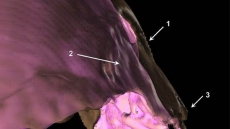
    After waking up from the surgery, Karanam was surprised to learn of the "teratoma"-her embryonic twin, a rarity in modern medicine, complete with bone, hair and teeth.
     
    "This is my second one, and I've probably taken out 7,000 or 8,000 brain tumours," said Dr. Hrayr Shahinian at the Skullbase Institute in Los Angeles, who performed the operation.
     
     
    It was only last September that Karanam realised something wasn't registering in her mind as she was experiencing trouble comprehending things she read.
     
    "Problems with reading comprehension, listening comprehension. If a couple people were talking in a room, I wouldn't understand what was happening," she was quoted as saying.
     
    What became more frustrating for Karanam was that her doctors would contradict each other regarding the source of the problem, NBC said.
     
    "The neurologist would say the neurosurgeon is not being practical in your case," Karanam said.
     
    "And the neurosurgeon would say the neurologist is not being optimistic in your case. And I'm like, could someone be educated about this?"
     
    Her own research led her to Shahinian who has developed a minimally-invasive way of reaching deep into the brain to extract tumours.
     
    "Unlike traditional brain surgery where you open the skull and use metal retractors and you bring a microscope to see in the depths of the brain, what we're doing is keyhole surgery," he was quoted as saying.
     
    The method uses fibre-optic technology with digital imagery. A half-inch incision into the brain allows for an endoscope to reach in and slowly and very delicately chisel away at the tumour.
     
    Shahinian said before he invented his technique, the only option to remove this type of tumour would have been surgery that included removing half of the skull.


    MORE Interesting ARTICLES

    'Dropped' calls may measure rainfall

    'Dropped' calls may measure rainfall
    We know that cellphone calls break up and crackle when it rains. But did you ever think that tracking this disruption in cellphone signals could help you calculate the amount of rainfall?

    'Dropped' calls may measure rainfall

    World's oldest recorded near-death experience found

    World's oldest recorded near-death experience found
    Researchers have stumbled upon what they believe to be the oldest professional/medical case report of near-death experiences (NDE) - dating back to the year 1740....

    World's oldest recorded near-death experience found

    Oldest evidence of human brain damage found

    Oldest evidence of human brain damage found
    Anthropologists have unearthed a 100,000-year-old skeleton of a child in Israel who may have died because of a brain injury - the oldest evidence of brain damage in a modern human....

    Oldest evidence of human brain damage found

    Bees physically transfer heat to stay cool

    Bees physically transfer heat to stay cool
    To protect their young ones from heat, honey bees can absorb heat from the brood walls just like a sponge and later transfer it to a cooler place to get rid of the heat

    Bees physically transfer heat to stay cool

    Global film industry gender-biased: Study

    Global film industry gender-biased: Study
    A study has revealed that only 22 percent of the crew involved in making 2,000 of the biggest grossing films worldwide over the past 20 years were women....

    Global film industry gender-biased: Study

    Consumers who feel 'special' hunt for unique products

    Consumers who feel 'special' hunt for unique products
    Consumers who attribute their successes to internal character traits rather than hard work are more likely to feel 'special' and hunt for unique products...

    Consumers who feel 'special' hunt for unique products