Maharaja Ranjit Singh was recently named as the “Greatest Leader of All Time” in a British poll.
He was one of the most powerful and charismatic Indian rulers of his age. While inspired by the Sikh faith’s ten founding gurus, the 19th century ruler of the Sikh Empire in India, Maharaja Ranjit Singh (1780–1839,) upheld the rights of all he came in contact with. The Maharaja was the founder of the Sikh empire and recently has been named as the “Greatest Leader of All Time” in a poll conducted by BBC World Histories Magazine. More than 5,000 readers voted in the poll. Singh was admired for creating a new tolerant empire, carrying more than 38 per cent of the vote.
The magazine asked the readers to vote for the greatest leader from the list of names that had been nominated by several renowned historians. Readers had to choose a leader who had “exercised power and had a positive impact on humanity and to explore their achievements and legacy.” Maharaja Ranjit Singh topped the poll.
Savvy and astute, the Maharaja’s appeasement of the East India Company was politically convenient, and reinforced a legacy centred around political fluidity, regional peace and harmony. While rapprochement with the East India Company angered the Maratha chieftains who were fighting it, this move countered the fact that preceding rulers — Mughals and Afghans — could not provide people with peace and security for generations.

With his shrewd knowledge of tribal rivalries among Afghans, the Maharaja made sure they were never able to unite to deprive him of his throne. Wisely, he also invested in a well-trained military force.
He unified the warring chiefdoms of the Punjab into a powerful northern Empire of the Sikhs stretching to the borders of Afghanistan and Tibet, built up a modern army, kept the British in check to the south of his kingdom and closed the Khyber Pass through which plunderers had poured into India for centuries beforehand. Yet, unique among empire builders, he was humane and just, gave employment to defeated foes, honoured religious faiths who did not follow Sikhi, and included Hindus and Muslims among his ministers.

Even though he is recognised as a Sikh icon across the globe, Ranjit Singh is also remembered for his secular credentials as both Hindus and Muslims were given important positions in his darbar. A devout Sikh, who never differentiated on religion, both his court and army had equal number of Hindus, Sikhs and Muslims – a true secular king.
His formidable modern army even recruited European officers to bring in the latest techniques of warfare. Hence the reason why British Rulers could not annex Punjab while he was alive. Because of him, Punjab was the last State which came under British rule in 1849.
His rule led to Punjab becoming the most literate state at that time. Even though he recruited European officers, he ensured they followed a strict code of conduct, no beef, no smoking and no alcohol. As a matter of fact, Ranjit Singh banned cow slaughter in his empire. His finance minister was a Hindu Brahmin, his Prime Minister was a Dogra, his foreign minister a Muslim.
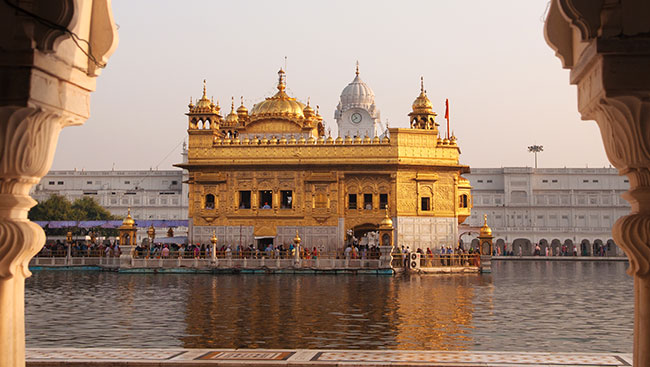
The legacy of his rule cuts through the maharaja’s military achievements and ends with the controversial period of the Anglo-Sikh Wars following his death, which saw the fall of his empire while in the hands of his successors whose internecine differences was exploited by the British. His contribution to making Amritsar’s Golden Temple one of the greatest religious pilgrimage sites in the world ensures that his legacy still inspires Sikhs all over the world.
ABOUT THE AUTHOR
Saurav Dutt is a British Author, Political Columnist and Human Rights Campaigner. He has written for Times of Israel, IB Times, and the American Herald Tribune. His works have been featured in TIME magazine, BBC and Sky News. His last book commemorated the Jallianwala Bagh Massacre of 1919.