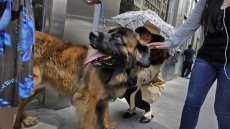
Your loving dog may have come into being independently from two separate -- possibly now extinct -- wolf populations that lived on opposite sides of the Eurasian continent, new research has revealed.
An international team of scientists compared genetic data with existing archaeological evidence and found that dogs may have been domesticated not once, as widely believed, but twice.
A review of the archaeological record shows that early dogs appear in both the East and West more than 12,000 years ago, but in Central Asia no earlier than 8,000 years ago.
"Our ancient DNA evidence, combined with the archaeological record of early dogs, suggests that we need to reconsider the number of times dogs were domesticated independently,” said professor Greger Larson from University of Oxford.
The project on dog domestication, led by University of Oxford, reconstructed the evolutionary history of dogs by first sequencing the genome (at Trinity College Dublin) of a 4,800-year old medium-sized dog from bone excavated at the Neolithic Passage Tomb of Newgrange, Ireland.
The team (including French researchers based in Lyon and at the National Museum of Natural History in Paris) also obtained mitochondrial DNA from 59 ancient dogs living between 14,000 to 3,000 years ago and then compared them with the genetic signatures of more than 2,500 previously studied modern dogs.
Combined, the new findings suggest that dogs were first domesticated from geographically separated wolf populations on opposite sides of the Eurasian continent.
At some point after their domestication, the eastern dogs dispersed with migrating humans into Europe where they mixed with and mostly replaced the earliest European dogs.
Most dogs today are a mixture of both Eastern and Western dogs -- one reason why previous genetic studies have been difficult to interpret.
The new genetic evidence also shows a population turnover in Europe that appears to have mostly replaced the earliest domestic dog population there, which supports the evidence that there was a later arrival of dogs from elsewhere.
"The Newgrange dog bone had the best preserved ancient DNA we have ever encountered, giving us prehistoric genome of rare high quality. It is not just a postcard from the past, rather a full package special delivery,” added senior author professor Dan Bradley from Trinity College Dublin in a paper appared in the journal Science.
"With so much new and exciting data to come, we will finally be able to uncover the true history of man's best friend,” noted professor Keith Dobney, co-author from Liverpool University.