Saturday, December 20, 2025
ADVT 
Interesting

Why No Alien Is Calling Us From Space, Explains Indian-Origin Scientist

Darpan News Desk IANS, 22 Jan, 2016 12:16 PM
    If the search for an alien life has not yielded any conclusive results in the last 50 years, it is probably because life on other planets was brief and has gone extinct soon after its origin owing to runaway heating or cooling on their planets, say astrobiologists led by an Indian-origin scientist.
     
    “The universe is probably filled with habitable planets, so many scientists think it should be teeming with aliens,” said Aditya Chopra from Australian National University (ANU).
     
    “Early life is fragile so we believe it rarely evolves quickly enough to survive,” he added in a paper published in the journal Astrobiology.
     
    “Most early planetary environments are unstable. To produce a habitable planet, life forms need to regulate greenhouse gases such as water and carbon dioxide to keep surface temperatures stable,” Dr Chopra continued.
     
    About four billion years ago the Earth, Venus and Mars may have all been habitable. However, a billion years or so after formation, Venus turned into a hothouse and Mars froze into an icebox.
     
    “Early microbial life on Venus and Mars, if there was any, failed to stabilise the rapidly changing environment,” said co-author associate professor Charley Lineweaver.
     
    “Life on Earth probably played a leading role in stabilising the planet's climate," he noted.
     
    According to Dr Chopra, their theory has solved a puzzle.
     
    “The mystery of why we haven't yet found signs of aliens may have less to do with the likelihood of the origin of life or intelligence and have more to do with the rarity of the rapid emergence of biological regulation of feedback cycles on planetary surfaces,” he explained.
     
    Wet and rocky planets, with the ingredients and energy sources required for life seem to be ubiquitous. However, as physicist Enrico Fermi pointed out in 1950, no signs of surviving extra-terrestrial life have been found.
     
    A solution to Fermi's paradox, say the researchers, is near universal early extinction which they have named the “Gaian Bottleneck”.
     
    "One intriguing prediction of the 'Gaian Bottleneck' model is that the vast majority of fossils in the universe will be from extinct microbial life, not from multicellular species such as dinosaurs or humanoids that take billions of years to evolve," Lineweaver pointed out.


    MORE Interesting ARTICLES

    Math can predict how body fights disease

    Math can predict how body fights disease
    Researchers, using mathematical models, have defined for the first time how powerfully immune cells respond to infection and disease....

    Math can predict how body fights disease

    Use a barcode scanner on your body parts and expect trouble

    Use a barcode scanner on your body parts and expect trouble
    Here's an "amusing trick", suggested by a reader. You get a barcode for Apple Inc. from the internet and glue it on a can of beans at your supermarket. ...

    Use a barcode scanner on your body parts and expect trouble

    17th century Polish 'vampire' graves found

    17th century Polish 'vampire' graves found
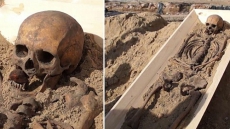
    Potential "vampires" in 17th-18th century Poland were buried with rocks and sickles across their bodies to ward off evil, scientists have discovered....

    17th century Polish 'vampire' graves found

    'I Saw Humans On Mars In 1979': Ex-NASA Employee

    'I Saw Humans On Mars In 1979': Ex-NASA Employee
    A woman claiming to be a former NASA employee has stated that while watching some footage, she saw two humans walking on the Red Planet towards the Viking Mars lander in 1979.

    'I Saw Humans On Mars In 1979': Ex-NASA Employee

    Clamouring For New Mollusk: Researchers Say New Species One-of-a-kind Find

    Clamouring For New Mollusk: Researchers Say New Species One-of-a-kind Find
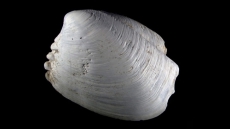
    VICTORIA — Ten years after an unusually scalloped clam was dragged up from the ocean floor off northern Vancouver Island, the tiny mollusk is making waves in the research world.

    Clamouring For New Mollusk: Researchers Say New Species One-of-a-kind Find

    How memory loss is inherited

    How memory loss is inherited
    In a bid to better understand inheritance of memory loss, scientists have now discovered two common gene variants that are believed to be associated with memory performance....

    How memory loss is inherited