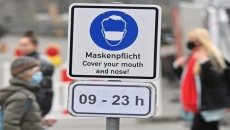
Even before the World Health Organization declared the COVID-19 pandemic was no longer a "public health emergency of international concern" on Friday, many Canadians had already given up wearing masks as mandates lifted in most public places.
Although WHO Director-General Tedros Adhanom Ghebreyesus noted Friday's declaration "does not mean COVID-19 is over," many people will likely interpret it that way, said Dr. Allison McGeer, infectious diseases specialist and microbiologist at Sinai Health Systems in Toronto.
"Truthfully, at least in Canada, most behaviour is already reflecting most people’s opinion that the pandemic is over," McGeer said.
LIVE Q&A on ending #COVID19 as a global health emergency with @DrMikeRyan and Dr @mvankerkhove. #AskWHO https://t.co/bn1ZBmclG4
— World Health Organization (WHO) (@WHO) May 6, 2023
Still, infectious diseases specialists are hoping the practice of masking, which emerged in this country as a response to the pandemic, will continue at certain times and in certain places to help reduce the spread of not only COVID-19, but influenza and respiratory syncytial virus (RSV) as well.
Although most mask mandates have been lifted, some large hospitals continue to require masking in patient-care settings, which makes sense to Dr. Lynora Saxinger, an infectious diseases specialist at the University of Alberta in Edmonton.
"In the 'before times,' which I think most of us can barely remember now, you'd be zooming around the hospital all over the place and people would have all sorts of symptoms," Saxinger said.
"You'd be seeing someone for possible pneumonia, they'd be coughing and you would just walk into the room ... So I think that there has been like a net shift in the willingness and proactiveness to using masks (in health care)," she said.
Dr. Fatima Kakkar, a pediatric infectious diseases specialist at CHU Sainte-Justine in Montreal, said she also intends to keep masking when seeing patients.
Masking not only helps protect the health-care provider, but also helps prevent the spread of viruses to other "very fragile patients" in the hospital, she said.
"I actually can't imagine seeing my patients without a mask on," Kakkar said.
Masking could be a "positive legacy" of the pandemic, she said.
"I hope in some sense it normalizes masking in these high-risk settings because, you know, it just becomes a reflex. You're going to see a high-risk cancer patient, you're going to see a high-risk newborn, it makes sense that you want to protect them."
Long-term care facilities and other congregate settings — such as group homes — are other "obvious" places where masking should be considered to protect vulnerable people, especially at times when there is a lot of COVID-19 or influenza circulating in the community, McGeer said.
"I think lots of people related to long-term care would be willing to wear masks if they didn't have to have outbreaks," she said.
But whether masking will continue to be used widely in hospitals and long-term care homes "(partly) depends on what's going to happen with COVID going forward," including whether it becomes a largely seasonal virus, McGeer said.
Saxinger said it's also important to assess each situation in hospitals and other health-care settings. For example, she may not put on a mask while walking down a hospital hallway, but might consider masking when approaching an elderly patient.
If an elderly patient is having trouble hearing her, "I might then take off my mask so they can understand me," she said.
Outside of health-care settings, doing that kind of risk assessment can help the general public decide whether or not to wear a mask under certain circumstances, infectious disease experts say.
People who are "immunocompromised and obviously more at risk if they catch something" may decide to continue wearing masks to protect themselves, McGeer said.
"I still encourage the elderly in my life ... that if they are taking a plane or they are going to be in high-risk settings to mask up," Kakkar said.
In addition to protecting themselves, people can also assess their risk to others, she said.
"The best principle is if you're sick, you stay home ... but that's not always feasible," said Kakkar.
In those cases, the next best thing would be to wear a mask while out, she said. "I do think if we could normalize that, it would help mitigate the spread."
In the end, "there's a fair amount of common sense" in deciding when and where to wear a mask, Saxinger said.
"Am I still masking at the grocery store? If I'm symptom-free and I don't have a cold or anything and I'm in a grocery store that's almost empty because I always go at odd hours, not necessarily," she said.
"Have I been around a lot of sick people lately in any kind of way that seems higher risk? And then if I go in and it happens to be seniors night or something at the grocery store, I might choose to mask."
It's also important for governments and public health authorities to make sure people have access to information, such as whether there's a high level of virus transmission in the community "that lets them make those decisions as they go," Saxinger said.
Although McGeer would like to see public health measures such as masking when needed and better handwashing continue, she's "not hopeful that many things will stay as legacies of COVID."
"The problem with pandemics is that the desire to put them behind us is so strong that it's really hard to hold on to anything," she said.