OTTAWA — A decision by the federal cabinet on renewing Canada's combat mission against the Islamic State is expected soon, but calls are getting louder for the Harper government to present a comprehensive war strategy beyond the military campaign.
It's widely expected that the federal government will deliver a motion to the House of Commons within the next couple of weeks, to renew and possibly reshape the commitment of warplanes and special forces against extremists in northern Iraq.
Prime Minister Stephen Harper has recently cast the conflict in wider terms, saying the terrorist organization and its affiliated jihadists have "declared war on Canada specifically."
But analysts and opposition critics say he and his ministers rarely discuss what diplomatic, development and humanitarian measures are needed to tackle the instability and sectarian divisions that feed the conflict.
Harper is not alone in facing that criticism.
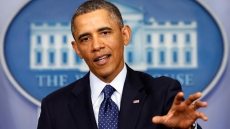
In the U.S., Barack Obama receives the same strident calls for clarity as his war resolution grinds its way through Congress.
"Warfighting is necessary, but it is only a means to an end and can only provide marginal benefits unless there is some meaningful strategy to bring broader stability in politics, governance, and development," said Anthony Cordesman, of the Center for Strategic and International Studies in Washington.
In Iraq, he says that "any meaningful and lasting form of victory means that it must emerge from the current conflict with some solution to the deep divisions between Arab and Kurd, and Sunni and Shiite."
The marginalization of the Sunni in the post-Saddam Hussein Iraq is one of the factors that contributed to the rise of the Islamic State.
Dave Perry, a senior analyst at the Canadian Defence and Foreign Affairs Institute, said the extremist organization is not gobbling up more territory, has been turned back in some places and political pressure needs to be applied to the root cause of the conflict.
"So, this is the point at which there is the need to have a coherent thought about how you actually do that," he said. "Trying to bridge the sectarian issue needs to be part of that. Seriously increasing the capacity of local security forces needs to be part of that too."
Across the border, it's a different story.
"Syria is far worse and presents the additional problem as to whether Iraq can ever be secured if Syria remains caught up in one of the modern world's civil wars," Cordesman wrote in a recent paper.
"Unlike Iraq, however, Syria shows no signs of moving toward any military progress or solution."

There is rising concern in Washington, the Gulf States, and even in Canada, to the increasing role Iranian-backed militia are playing in pushing back the extremists in Iraq. Cordesman warns there must be a functioning government in Baghdad that provides security and the ability to move toward some workable path of development.
"A Shiite-led occupation of Sunni areas may be better than an Islamic State occupation, but it will not solve Iraq's political, governance, security, and stability problems," he said.
Nipa Banerjee, who ran Canada's aid program in Afghanistan, says post-war planning needs to be done now and not — as in both Iraq in 2003 and Afghanistan — after the fighting ends.
"There has to be a very, very intensive analysis of the situation before you get involved, and that was not done (in Afghanistan)," said Banerjee who now teaches at the University of Ottawa.
Canada's involvement in the Afghan war was dominated by the military mission until a blue ribbon panel, led by former deputy prime minister John Manley, set some clear goals and expectations.
While the Harper government may not be able to drive coalition strategy against the Islamic State, analysts say it can diplomatically set the tone and encourage thinking and debate.
Banerjee said it's important that Canada set itself apart from the U.S.-led coalition in the eventual postwar Iraq because American credibility is still deeply undermined by the 2003 war and occupation.
"What the U.S. had done in Iraq, that is not forgotten by the people and they don't distinguish between U.S. and Canada that much," she said.