The world buckled up for another roller-coaster ride of uncertainty this week as U.S. President Donald Trump's sweeping tariff agenda made its way through the courts.
A federal appeals court on Thursday granted the Trump administration's emergency motion to temporarily stay a decision from the U.S. Court of International Trade that blocked many of the president's tariffs.
The lower court on Wednesday ruled that Trump's use of an emergency powers law to impose tariffs exceeded his authority.
Here's a quick look at what it all means for Canada.
—
What's happening with tariffs
The federal appeals court granted the Trump administration's emergency motion, essentially freezing a decision by the U.S. Court of International Trade blocking the so-called "Liberation Day" and fentanyl-related tariffs.
That means that countries will continue to be hit by those duties for now. They include 25 per cent tariffs on all Canadian imports not compliant with the Canada-U.S.-Mexico Agreement on trade, with a lower 10 per cent levy on energy and potash.
The appeals court said the request for a stay was granted "until further notice while this court considers the motions papers." It said the plaintiffs have until June 5 to reply to the administration's motion for a stay, while the administration "may file a single, consolidated reply in support" of the motion no later than June 9.
George Mason University law professor Ilya Somin said in an online post that it was a "a brief temporary stay intended to give the court time to consider whether a longer stay should be imposed." Somin, along with the Liberty Justice Center, represents American small businesses in the case against the tariffs.
—
What the White House argued
In its emergency motion to the appeals court, the Trump administration argued the U.S. Court of International Trade's injunction blocking the tariffs was "unprecedented and legally indefensible."
The motion said blocking the tariffs threatens "to unwind months of foreign policy decision-making." It said agreements with multiple countries could "be immediately unravelled."
Trump's administration argued that if a stay was not granted, it would seek emergency relief from the Supreme Court on Friday.
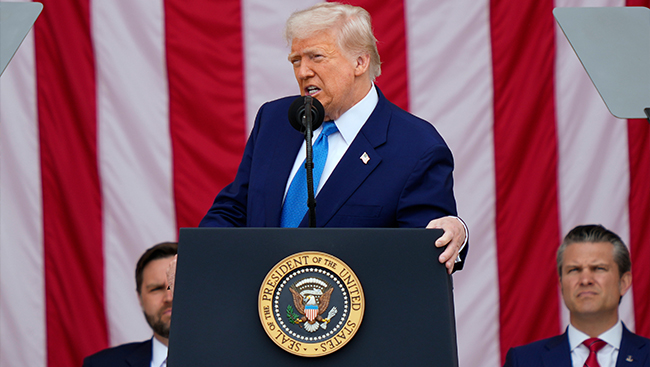
White House Press Secretary Karoline Leavitt said earlier Thursday that the Supreme Court should "put an end to this" and called the lower court's decision "judicial overreach." She maintained that Trump had the legal authority to use the International Emergency Economic Powers Act to implement tariffs.
—
The U.S. Court of International Trade's decision on IEEPA
Trump used the International Emergency Economic Powers Act of 1977, usually referred to by the acronym IEEPA, to implement his most sweeping tariffs. While the national security statute gives the U.S. president authority to control economic transactions after declaring an emergency, it had never previously been used for tariffs.
The U.S. Constitution gives power over taxes and tariffs to Congress. The trade court wrote that "because of the Constitution's express allocation of the tariff power to Congress … we do not read IEEPA to delegate an unbounded tariff authority to the President."
"We instead read IEEPA's provisions to impose meaningful limits on any such authority it confers," it added.
Mona Paulsen, an associate international economic law professor at the London School of Economics, said the decision is significant because it shows there are limits to the main tool Trump's administration had used in its attempts to realign global trade.
—
What the lower court said about tariffs
Trump declared emergencies at the United States' northern and southern borders linked to the flow of fentanyl to hit Canada and Mexico with economywide tariffs. He later declared an emergency over trade deficits to impose his retaliatory "Liberation Day" duties on most nations.
The trade court wrote that "the Worldwide and Retaliatory Tariff Orders exceed any authority granted to the President by IEEPA to regulate importation by means of tariffs."
It separately found that "the Trafficking Tariffs fail because they do not deal with the threats set forth in those orders."
—
Which tariffs aren't affected by this court ruling
Trump is hitting Canada, and the world, with 25 per cent tariffs on steel and aluminum.
The president has also implemented 25 per cent duties on automobiles, with a partial carveout for cars compliant with the Canada-U.S.-Mexico Agreement on trade. Those vehicles are being slapped with tariffs on their non-American components.
Trump used the Trade Expansion Act of 1962 to enact those duties. The president has launched trade investigations to use the same tool to tariff other imports, such as pharmaceuticals and semiconductors, in the future.
Leavitt said Trump will also look at other tools to continue his wide-ranging tariff agenda.
Picture Courtesy: AP Photo/Julia Demaree Nikhinson