OTTAWA - Even if the Hong Kong protests fizzle, Stephen Harper must press his Chinese hosts next month on the concerns raised by student activists, says a former Canadian ambassador.
David Mulroney, who served as Canadian envoy to Beijing from 2009 to 2012, said even though Canada needs China trade to grow its economy, it still has to find a way to talk about important issues that cut to the core of democratic beliefs.
The Hong Kong student protests place Harper and some of his fellow Western leaders in a potentially awkward position as they head to the November APEC summit in Beijing. The 21-member APEC bloc also includes the United States and Australia, as well as Russia.
"It's really, really important that we all get better at doing this because this challenge isn't going away," Mulroney said in a recent interview.
"I think we're getting a glimpse of our future in all of this."
An estimated 200,000 people, mainly students, took to Hong Kong's streets late last month to protest a decision by its Chinese-backed leader to install a pro-Beijing committee to choose the candidates who will run in the 2017 elections to replace him.
Their numbers have since declined sharply. But clashes between police and demonstrators erupted on Tuesday night after hundreds of police moved in to remove barricades using power saws and bolt cutters.
Mulroney said it is important for Canada, the U.S. and Australia "to find a voice and express themselves about the issue at the heart of the protests: and that is, a rather inadequate definition of universal suffrage."
And they have to find a way to do that while still pursuing their own economic interests with China, he added.
"China will remain an inevitable partner if we want to grow our economy," said Mulroney, now a senior fellow at the University of Toronto's Munk School of Global Affairs.
"And at the same time, we have to manage the difficulties that come with a country that is as different and unpredictable as is China."
Harper is under pressure to reset relations with China after a series of recent setbacks. Harper blamed China for a cyber attack on the National Research Council, angering Chinese leadership. China has since arrested a Canadian couple living in Beijing, labelling them spies.
Last month, Ottawa announced that the government had finalized a contentious Foreign Investment Protection Agreement, but not before a two-year delay that also rankled Chinese leaders.
China is a key to Harper's economic strategy, because he has made boosting Canadian trade with Asia a major priority.
Wenran Jiang, a China expert from the University of Alberta and director of the Canada-China Energy and Environment Forum, said he believes the Hong Kong protests are dying down and won't be an issue by the time Harper and his fellow leaders arrive in Beijing.
He said that will suit Western leaders, who would like to see them die out too "rather than dealing with it up front."
Jiang said Chinese leader have already placed relations with Canada "on the back burner" because of the recent irritants, so there's little upside for Harper.
"At the moment, Harper is in a very awkward position. APEC is very important. There are a lot of reasons for him to go there," said Jiang.
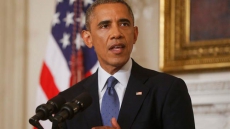
As for U.S. President Barack Obama, Jiang suggested he won't have much moral authority over his Chinese hosts given the ongoing unrest in Ferguson, Mo., after the shooting of a black teenager by a white police officer this summer.
"It's wise not to be seen as interfering unnecessarily when the scale of the matter is not really a big deal in comparison to what's going on in the rest of the world," said Jiang.
"Would the Chinese respond by raising the Ferguson protests?"