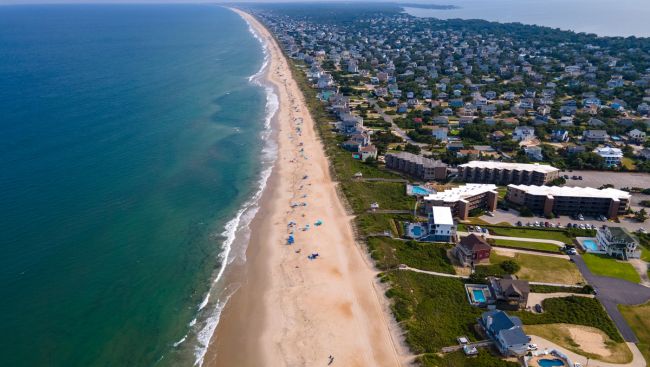
There's a popular T-shirt on Hatteras Island along the North Carolina Outer Banks that says: “One road on. One road off (sometimes)” — poking fun at the constant battle between Mother Nature and a thin ribbon of pavement connecting the narrow barrier island to the rest of the world.
Mother Nature is probably going to win this week. Hurricane Erin is forecast to stay hundreds of miles offshore but is still sending waves 20 feet (6 meters) or greater crashing over vulnerable sand dunes on the islands.
Officials have ordered evacuations of Hatteras and Ocracoke islands even without a hurricane warning because that tiny ribbon of highway called N.C. 12 will likely be torn up and washed out in several places, isolating villages for days or weeks.
The 3,500 or so Outer Bankers who live there have handled isolation before. But most of the tens of thousands of vacationers have not.
“We haven't seen waves of that size in a while and the vulnerable spots have only gotten weaker in the past five years,” said Reide Corbett, executive director of the Coastal Studies Institute, a group of several universities that study the Outer Banks.
The Outer Banks are defined by water
In a basic sense, they are sand dunes that were tall enough to stay above the ocean level when many of the Earth's glaciers melted 20,000 years ago.
The barrier islands in some places are as far as 30 miles (48 kilometers) off mainland North Carolina. To the east is the vast Atlantic Ocean. To the west is the Pamlico Sound.
“Water, water everywhere. That really resonates on the Outer Banks,” Corbett said.
The most built-up and populated part of the Outer Banks are in the north around Nags Head and Kill Devil Hills, which aren't under the evacuation order. South of the Oregon Inlet, scoured out by a 1846 hurricane, is Hatteras Island, where the only connection to the mainland is N.C. 12. South of there is Ocracoke Island, accessible only by boat or plane.
The first highways to reach the area were built more than 60 years ago. And the Outer Banks started booming, as it went from quaint fishing villages to what it is now, dotted with 6,000-square-foot (550-square-meter) vacation homes on stilts.
Maintaining the highway is arduous
On a nice day, what look like snowplows and street sweeper brushes wait on the side of N.C. 12 to scoop and sweep away the constantly blowing sand.
When the storms come, water from the ocean or the sound punch through the sand dunes and wash tons of sand and debris on the road. In more extreme cases, storms can break up the pavement or even create new inlets that require temporary bridges.
The N.C. Department of Transportation spent more than $1 million a year on regular maintenance to keep N.C. 12 open during the 2010s. It also spent about $50 million over the decade on repairs after storms.
But the state estimates Dare County, which includes most of the Outer Banks, brings in $2 billion in tourism revenue a year. So the cycle of clean up and repair continues.
The repairs take time. Hurricane Isabel in 2003 and Hurricane Irene in 2011 both cut inlets into Hatteras Island and ferries were needed for two months. It can still take days to reopen N.C. 12 after more routine Nor'easters.
The erosion is constant
It's not just storms that impact the island. As the planet warms and polar ice melts, rising ocean levels threaten the Outer Banks. In a place where most of the land is only a few feet above sea level, every inch of sand counts.
In the town of Rodanthe, which sticks the farthest out into the Atlantic, the churning ocean has swallowed up more than a dozen homes since 2020. Officials think at least two unoccupied houses are likely to be lost if the waves from Erin are as strong as predicted.
The Outer Banks are still home
Shelli Miller Gates waited tables on the Outer Banks to earn money as a college student in the late 1970s. She remembers houses with no air conditioning, televisions or phones. And she adored it.
“I love the water. I love the wildness of it. It’s the way I want to live my life," the respiratory therapist said.
It's a lifestyle embraced by many. The area's shorthand “OBX” shows up in many places as a source of pride, including the first three letters on license plates issued by the state.
The isolation contributes to a sense of community. Gates has seen people band together countless times when their connection to the outside world is severed. And there is always the allure of getting to live someplace where others just get to visit.
“There’s things everywhere. There’s earthquakes and blizzards and floods. Look at the poor people out in western North Carolina,” Gates said. “There are so many things that can happen to you. I feel like you have to find the place that feels like home.”
Picture Courtesy: AP Photo/Ruth Fremson, File