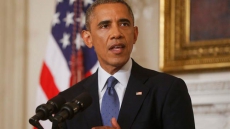
Several Indian-Americans are among over 100 students from across the country who would showcase their inventions, and innovative science projects at the fifth White House Science Fair hosted by President Barack Obama Monday.
Celebrating their extraordinary science, technology, engineering, and math (STEM) achievements, this year's exhibits, all built, made, and designed by kids, range from patented inventions to award-winning rockets and robots.
Here are the inventions, discoveries, and science projects of five Indian-American students as outlined by the White House Trisha Prabhu, 14 Naperville, Illinois:
Trisha learned about research showing that the human brain's decision-making region is not fully developed until age 25 and got inspired to help teens rethink how they treat others.
She developed a computer programme called "Rethink" that alerts users when an outgoing message contains language that is potentially abusive and hurtful.
Preliminary analysis showed that adolescents who use the "Rethink" system are 93 percent less likely to send abusive messages than those who are not warned about the consequences of their actions prior to sending a message.
Trisha earned a spot in the 2014 Google Science Fair to showcase her innovative project.
Sahil Doshi, 14, Pittsburgh, Pennsylvania:
Inspired by the global energy crisis and the lack of electricity around the world, Pittsburgh ninth-grader Sahil Doshi designed an innovative carbon-dioxide powered battery called PolluCell.
Comprised of multiple electrochemical cells wired in parallel circuits, PolluCell harnesses the power of carbon dioxide and waste materials to generate electricity, reducing the environmental effects of pollution.
The battery earned him $25,000 and the title of America's Top Young Scientist at the 2014 Discovery Education 3M Young Scientist Challenge.
Nikhil Behari, 14, Sewickley, Pennsylvania
After hearing about major data breaches at retail chains, Nikhil Behari got inspired to create a security system that is easy to use, versatile and effective in protecting online data.
Nikhil wondered if the manner in which people type could be used as a means of secondary authentication for safer passwords.
He connected sensors to a microprocessor he had programmed to detect keystroke pressure, and used a separate program to measure action and pause time as users type.
By analyzing data from these devices, Nikhil discovered that keystroke-based authentication is a potentially powerful technique for distinguishing and authenticating individuals.
Nikhil won a second place award in Technology at the 2014 Broadcom MASTERS national finals.
Ruchi Pandya, 18, San Jose, California
Combining nanotechnology, biology and electrochemistry, Ruchi Pandya's research requires small biological samples - only a single drop of blood - to test for specific cardiac biomarkers.
She developed a one-square centimetre carbon nanofiber electrode-based biosensor that has the potential to improve cardiac health diagnostics for patients around the world.
Ruchi takes her passion for STEM education beyond the lab by mentoring 9th and 10th grade students on research and engineering as a teaching assistant for her school's STEM-research class.
She has competed at the California State Science Fair every year, and has won 18 category and special awards for scientific research.
After graduation, Ruchi intends to major in materials science and engineering, and hopes to pursue a career as a technology entrepreneur.
Anvita Gupta, 17, Scottsdale, Arizona:
Anvita Gupta used machine learning to "teach" a computer to identify potential new drugs for cancer, tuberculosis, and Ebola.
She combined artificial intelligence techniques, 3D visualization and biomimicry to systematically discover which drugs might inhibit the interactions of intrinsically disordered proteins with other proteins.
These proteins make up 70 percent of all cancer proteins and are mutated in tuberculosis and Ebola.
She's also an advocate for getting more girls in science fields - starting an after-school computer science group to teach middle school girls programming and app development. Forty girls enrolled the first year.
Anvita's research earned her Third Place Medal of Distinction for Global Good at the 2015 Intel Science Talent Search.