WASHINGTON — The U.S. government has increasingly been using "Daesh" as its preferred name for the Islamic State of Iraq and the Levant, the murderous militant group also known as ISIS, ISIL and the Islamic State. Some facts:
— Abu-Musab al-Zarqawi travelled to Afghanistan near the end of the clash with the Soviets, met Osama bin Laden, and in his native Jordan later founded a group called Unity and Jihad.
It became Al-Qaida in Iraq, after he pledged loyalty to bin Laden's group during the war against U.S. forces there. It split with al-Qaida over tactics and strategy after al-Zarqawi's death, adopting a new name that translated as the Islamic State of Iraq and al-Sham. It later shortened its name to "Islamic State."

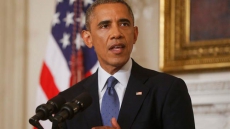
— Al-Sham is a historic Islamic term for the land bordering the eastern Mediterranean. The closest traditional English equivalent for al-Sham is "the Levant" — hence the Islamic State of Iraq and the Levant (ISIL), U.S. President Barack Obama's preferred term.
— Most of the group's opponents in the Arab world use a version of "Daesh." The Spanish government followed suit last year. The French use it consistently. U.S. Secretary of State John Kerry explained last year why he preferred the term. Obama's started too, although he mainly uses ISIL.

— Daesh is an acronym that sounds closer to the Arabic name — and like an insult. It resembles the Arabic word "daes," which refers to something that stomps, or crushes. It strips the group of its self-proclaimed importance. It's the term preferred by Arabs who oppose the group.
—The Associated Press reported that ISIL hates the name so much that it threatened to cut out the tongue of Iraqis who used it after it invaded Mosul last year. A core part of its mythology is that it is the modern-day heir to the original Muslim caliphates, which requires being seen as "Islamic," and a "state."
ISIL Vs. Daesh: Why The U.S. Ambassador Changed How He Refers To Militant Group

WASHINGTON — The U.S. ambassador to Canada is using yet another name — "Daesh" — for the multi-monikered terrorist group known variously as the Islamic State of Iraq and the Levant (ISIL), the Islamic State of Iraq and Syria (ISIS) and the Islamic State.
Politicians are increasingly using the D-word for two simple reasons: to strip the group of its credibility and to steer away from the Islam-versus-the-West dynamic it apparently craves.
"I'm using the term 'Daesh' now, instead of ISIL," Bruce Heyman said in an interview.
"I think it's unfair to refer to Islam, and it's totally inappropriate to think of it as a state — so anything calling it the 'Islamic State' is wrong."

Heyman used the Arabic acronym in a speech Tuesday to a Toronto conference on Canadian business opportunities in the U.S., which began with a moment of silence in honour of the victims of last week's Paris attacks.
The wording might even strike some as trivial, given the bloodshed. But the evolution of the group's name offers a window into its history, its place in the Arab world and the bewilderment it has provoked in the West.
Arabs who oppose the group customarily use a version of Daesh, as do European politicians and U.S. Secretary of State John Kerry, among others. Although he usually prefers ISIL, President Barack Obama used the term a few times at this week's G20 summit in Turkey.
The group apparently hates it so much it threatened to cut out the tongues of those who use it, The Associated Press reported last year when the group seized the Iraq city of Mosul.

That's because it sounds like an insult, resembling the Arabic word "daes," which refers to something that stomps, or crushes. It's considerably less important-sounding than "Islamic State," which Egyptian religious authorities have pleaded for western journalists to stop using.
The group's core mythology relies on being perceived as both Islamic and a state, and the modern-day heir to the original 1,400-year-old caliphates.
The group began with Abu-Musab al-Zarqawi, the Jordanian jihadist who travelled to Afghanistan on the tail end of the war with the Soviets. He met Osama bin Laden there. He later founded a group called Unity and Jihad, which became Al-Qaida in Iraq when he pledged loyalty to bin Laden's group during the war against U.S. forces there.
It split with al-Qaida after al-Zarqawi's death. The group adopted its more recent names from the Arabic, "Dawlah al-Islamiyah fi 'l-'Iraq wa-sh-Sham," as it seized territory in Syria and Iraq.

Confusion over the ISIS-versus-ISIL acronym stems from that last part — al-Sham.
That's a historic Islamic term for the land bordering the eastern Mediterranean, including Syria. Al-Sham stems from the words for, "left hand." That's opposed to Yemen, which stems from, "right hand." In the centre? The holy land of Mecca.
The closest traditional English equivalent for al-Sham is "the Levant," hence the Islamic State of Iraq and the Levant, or ISIL.
In a recent blog post, Alice Guthrie, an Arabic translator living in England, advocated for the use of Daesh earlier this year, and criticized the world's English-language media for doing a poor job explaining the term.
"At the secular level, satire is a crucial weapon in the fight against these maniacs," Guthrie writes.

"So the insult picked up on by Daesh is not just that the name makes them sound little, silly, and powerless, but that it implies they are monsters, and that they are made-up."