LONDON - Islamic militants are using a beheading video to send a chilling message — not just through the gruesome act, but also by the choice of messenger.
The black-clad fighter who appears to kill journalist James Foley speaks with an English accent, underscoring the insurgents' increasing use of Western militants to mobilize recruits, terrify opponents and project the image of a global force.
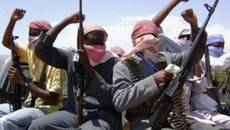
He is the latest in a string of international jihadis — Britons, Australians, Chechens, Chinese and Indonesians — to appear in propaganda for the Islamic State group.
"They like to suggest they have a presence around the world much stronger than it is," said Charlie Cooper, a researcher at the Quilliam Foundation, a British counter-extremism think-tank . "It does suggest that people all over the world are going off to fight in the tens of thousands."
U.S. officials have confirmed the grisly video is authentic — an act of revenge for U.S. airstrikes in northern Iraq. In Britain, the investigation focuses on the masked attacker. British Prime Minister David Cameron said the man had not yet been identified, but "from what we have seen it looks increasingly likely that is a British citizen."
Linguists described the man's accent as "multicultural London English," spoken by many young, inner-city residents from a variety of ethnic backgrounds.
"He sounds to me like a native speaker ... or a non-native who has spent a lot of time in London," said Dominic Watt, a forensic linguist at the University of York. Jane Setter, a professor of phonetics at the University of Reading, said the man was likely educated in the U.K. or in a U.K.-based system.
"They clearly wanted to use a fluent English speaker to ensure the clip was widely used in the U.S. media," said Peter Neumann, the director of the International Center for the Study of Radicalization at King's College London. "An American would have been ideal, but there still aren't many American fighters in the conflict, and it may have been difficult to find one in the place where the hostage was held."
Syria's civil war, in its fourth year, has attracted thousands of foreign fighters from around the world. Several hundred people from Britain have travelled to Syria, according to official estimates, and some may have crossed into Iraq as Islamic State militants advanced. France and Germany have estimated a combined 1,300 of their citizens have joined the fight.
Shiraz Maher, another expert at the International Center for the Study of Radicalization, said the video is evidence that British jihadis are "some of the most vicious and vociferous fighters" in Syria and Iraq.
"We have seen British fighters out there operating as suicide bombers; we have seen them operating as executioners," Maher told BBC radio.
Extremists have increasingly used their international components for propaganda purposes.
In June, the Islamic State released a video showing British and Australian militants exhorting compatriots to join them in violent jihad. Last month, an al-Qaida-linked group in Syria released a video of an American carrying out a suicide attack.
An Islamic State fighter from Australia posted a picture on Twitter showing his 7-year-old son holding the severed head of a Syrian soldier — an image U.S. Secretary of State John Kerry called "one of the most disturbing, stomach-turning, grotesque photographs ever displayed."
One of the group's most prominent commanders, appearing frequently in online videos, is Omar al-Shishani, a red-bearded ethnic Chechen.
Nigel Inkster, a terrorism expert at the International Institute for Strategic Studies, said the videos reflect an increasingly sophisticated media strategy designed to energize recruits and give the West a message "of fear and a perception of inevitability."
He said showcasing large numbers of foreign — and particularly Western — fighters is intended to tell potential recruits that the Islamic State is "a successful movement, ... and if you want to be a jihadi you have to be part of it."