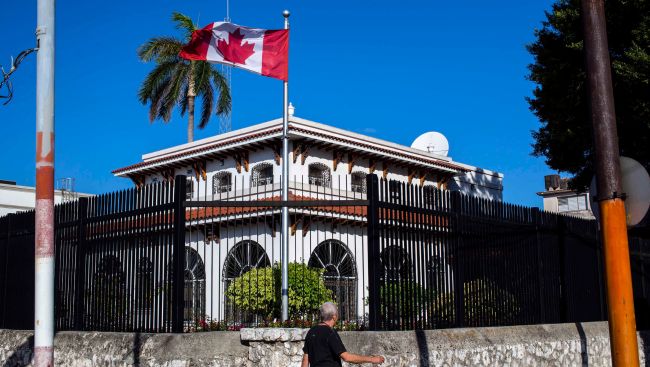
A lawyer for Canadian diplomats and their families says he believes the mysterious ailments they suffered in Cuba were caused by a foreign adversary, despite a federal government report that dismisses the theory.
Eight years after foreign service officials and their dependants began reporting such symptoms as headaches, memory loss, mood changes, vision problems, nausea and nosebleeds, a legal action against Ottawa over the health problems is still grinding along in Federal Court.
The 17 plaintiffs, who seek millions of dollars in damages, allege the Canadian government failed to protect them, hid crucial information and downplayed the seriousness of the risks. The government has denied negligence and wrongdoing.
Several U.S. personnel who worked in Cuba have reported similar health issues, commonly known as Havana Syndrome. Theories about the cause have included pesticide spraying, the effect of chirping crickets, malfunctioning eavesdropping devices, and targeted energy or sonic attacks by an enemy state.
The Canadian government says it has found no evidence of foul play by a foreign adversary.
A Global Affairs Canada report completed in August 2024 says the department has concluded that the unexplained health incidents "were not the result of a malicious act of a foreign actor."
The report, drawing on the work of an interdepartmental task force and external experts, says pre-existing medical conditions, environmental factors and conventional illnesses "were likely to have been important factors in many of the symptoms experienced."
The report adds that the findings "do not cast doubt on the authenticity of the symptoms reported by staff members and their dependants."
Paul Miller, a lawyer for the plaintiffs, told The Canadian Press he is "very confident" a foreign actor is to blame for the Canadians' health difficulties.
"I really trust the people that I have spoken with and met with," he said.
"I have absolutely no faith in the (Global Affairs Canada) report because they are trying to put out the narrative that works for them."
The plaintiffs' court action, filed in 2019, remains unresolved.
Three years ago, the parties agreed to the appointment of a former Supreme Court judge to mediate the claims of nine family members in the case.
Miller said the two days of talks in early 2023 "just went nowhere."
He said he has made efforts to file new information in the case but the material is being treated as confidential pending the resolution of concerns about the disclosure of sensitive or potentially injurious information, as defined by the Canada Evidence Act.
The Global Affairs report traces the various steps federal agencies have taken over the years in response to the illness complaints, including security, medical and environmental assessments.
A multi-agency Integrated National Security Enforcement Team, led by the RCMP, opened an investigation in June 2017.
Global Affairs and RCMP officials began travelling regularly to Cuba as part of the investigation to look at the possibility of malicious attacks, the report says. Canadian officials also shared information with foreign partners, including the United States.
In 2019, instruments designed to detect and capture evidence of acoustic and radiation surges, and to measure environmental effects — such as temperature, humidity, barometric pressure and ozone levels — were installed in the living quarters of Canadian staff in Havana.
"The data collected from the instruments did not provide relevant and probative information to identify a cause for the symptoms," the Global Affairs report says. "As such, in 2022, the instruments were removed."
The integrated national security team concluded "there was no criminality and no evidence attributing these health symptoms to a foreign actor," the report adds.
"In their conclusions, the RCMP and other domestic partner agencies assess that there is no known criminality, no known attribution for (unexplained health incidents) and no patterns related to symptoms, age, gender, location, or other variable."
The U.S. intelligence community looked at possible evidence of a foreign adversary's involvement, the feasibility of tools that could cause the reported symptoms and whether medical analysis could help find answers.
A March 1, 2023, report from the U.S. National Intelligence Council said these lines of inquiry led most intelligence community agencies to conclude — with varying levels of confidence — that it was "very unlikely" a foreign adversary was responsible for the health issues reported by American personnel.
Global Affairs, the Canadian Security Intelligence Service and the RCMP subsequently met to discuss the U.S. council's findings.
The RCMP indicated that "since no criminality was uncovered, its criminal investigation would be concluded," and CSIS advised it also would be wrapping up its investigations for similar reasons, the Global Affairs report says.
Overall, the Canadian efforts "have not uncovered a clear common cause of the symptoms experienced by government of Canada employees," the report adds. "Canada's findings are aligned with the conclusions of the United States on their various health studies and the security report published by the National Intelligence Council."
Miller points to other research and testimony that challenge those findings.
Lawyer Mark Zaid, representing several U.S. personnel with symptoms, told a congressional hearing in May 2024 there was intelligence, scientific and medical evidence substantiating the reports of anomalous health incidents, and that some were caused by a foreign adversary.
Zaid, who had authorized access to secret details, said he was convinced that "the evidence that exists in the classified arena directly contradicts the public conclusions" provided by U.S. federal agencies about the cause of the health symptoms.
Global Affairs says it stands by the findings of its 2024 report.
Department spokesperson John Babcock said the foreign ministry continues to support the Canadian diplomats and their dependants.
"For privacy and security reasons, Global Affairs Canada cannot comment on the specifics of the ongoing investigations, individual cases, nor on specific security measures," he said in an emailed response to questions.
Picture Courtesy: AP Photo/Desmond Boylan, File