Monday, February 2, 2026
ADVT 
International

'Nanoflares' behind heating of the Sun's corona

Darpan News Desk IANS, 18 Oct, 2014 07:43 AM
    Providing a clue to why the Sun's corona is so much hotter than its surface, a study found that miniature solar flares called 'nanoflares' and the speedy electrons they produce may be the source of that heat.
     
    A solar flare occurs when a patch of the Sun brightens dramatically at all wavelengths of light.
     
    During these flares, solar plasma is heated to tens of millions of degrees in a matter of seconds or minutes.
     
    Flares also can accelerate electrons (and protons) from the solar plasma at the speed of light.
     
    Those speedy electrons also can be generated by scaled-down versions of flares called nanoflares.
     
    "These nanoflares, as well as the energetic particles possibly associated with them, are difficult to study because we can't observe them directly," said Paola Testa from the Harvard-Smithsonian Center for Astrophysics (CfA) in the US.
     
    Using the observations from the Interface Region Imaging Spectrograph (IRIS), the team found that IRIS provides a new way to observe the telltale signs of nanoflares by looking at the footpoints of coronal loops.
     
    The team inferred the presence of high-energy electrons using IRIS high-resolution ultraviolet imaging and spectroscopic observations of those footpoint brightenings.
     
    Using computer simulations, they also outlined the response of the plasma, confined in loops, to the energy transported by energetic electrons.
     
    Finding high-energy electrons that aren't associated with large flares suggests that the solar corona is, at least partly, heated by nanoflares, noted the study.
     
    The new observations help astronomers to understand how electrons are accelerated to such high speeds and energies - a process that plays a major role in a wide range of astrophysical phenomena from cosmic rays to supernova remnants, concluded the team.
     
    The study appeared in the journal Science.

    MORE International ARTICLES

    Kerry, Arab League chief discuss terrorism, regional issues

    Kerry, Arab League chief discuss terrorism, regional issues
    Arab League Secretary General Nabil el-Arabi Saturday said his meeting with visiting US Secretary of State John Kerry focused on means to face...

    Kerry, Arab League chief discuss terrorism, regional issues

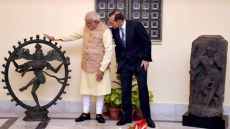
    Australia hails return of 11th century idols to India

    Australia hails return of 11th century idols to India
    The Australian High Commission Friday hailed the recent return to India of two 11th century idols from Tamil Nadu.

    Australia hails return of 11th century idols to India

    Facebook sorry after rejecting dad's ad to help baby

    Facebook sorry after rejecting dad's ad to help baby
    Facebook has apologised to a father after rejecting his advertisement on the social networking site asking people to donate money for his two-month-old son's heart transplant....

    Facebook sorry after rejecting dad's ad to help baby

    Mixed reactions to Obama's strategy to tackle IS

    Mixed reactions to Obama's strategy to tackle IS
    From scepticism to support, there were mixed reactions from key stakeholders Thursday to US President Barack Obama's announcement of sweeping...

    Mixed reactions to Obama's strategy to tackle IS

    Oscar Pistorius found not guilty of murder

    A court in South Africa Thursday found paralympian Oscar Pistorius "not guilty" of premeditated murder or murder of his girlfriend Reeva Steenkamp in 2013, a case...

    Oscar Pistorius found not guilty of murder

    Turkey reluctant to allow US use its airbase against IS

    Turkey reluctant to allow US use its airbase against IS
    Turkey is not eager to allow a US-led coalition to use its Incirlik Air Base to launch attacks on militants of the Islamic State (IS) Sunni extremist group in neighbouring...

    Turkey reluctant to allow US use its airbase against IS