WASHINGTON - In making the case for U.S. airstrikes in Iraq, President Barack Obama is drawing on the doctrine involving the use of American force that he outlined less than three months ago, when it seemed he was trying to avoid potential U.S. military action anywhere.
In a late May speech at the U.S. Military Academy, Obama said he would use military force under two scenarios: a direct threat against Americans or U.S. interests, and a humanitarian crisis on a scale that he said would "stir the conscience."
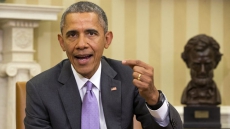
On Thursday night, when Obama announced that he had authorized airstrikes and humanitarian airdrops in Iraq, he argued that both conditions were being met.
"When the lives of American citizens are at risk, we will take action," Obama declared Thursday. "And when many thousands of innocent civilians are faced with the danger of being wiped out and we have the capacity to do something about it, we will take action."
U.S. military jets have conducted several airstrikes on militant targets near Iraq's Kurdish capital of Irbil, home to a U.S. consulate and about three dozen American military trainers. The U.S. military also has undertaken two airdrops of food and water for Iraqis under siege from the Islamic State group, and Obama has authorized strikes if needed to protect the civilians.
The deteriorating situation appears to fall within the parameters for military action Obama outlined. Yet the shift from a theoretical argument about using force to actually doing just that will test the scope and application of Obama's policy.
Already Obama is facing the question of why Iraq's besieged religious minorities are worthy of U.S. military support, but not those in the civil war in Syria, where 170,000 people have died.
The same question could apply to the violence in the Central African Republic or the Congo.
Frederic Hof, a senior fellow at the Rafik Hariri Center for the Middle East, said that even though he welcomed Obama's decision in Iraq, it was inevitable that "those who have called for a similar humanitarian intervention in Syria will wonder why Iraq and why not Syria."
Obama's advisers say there are important differences between Iraq and Syria. Officials note that Obama is undertaking military action in Iraq at the invitation of that country's government, while in Syria, U.S. intervention would aim to oust Syrian President Bashar Assad.
Officials also say that the ties built between the U.S. and Iraq during nearly a decade of war have left the military with significant intelligence and surveillance resources that provide keen insight into the situation there. Such resources, officials say, do not exist in Syria.
"While there are lessons that can be drawn from our involvement in other places, there is no direct correlation between action in one place and action in another in terms of guiding the decisions that are made solely by the consequences for American national security," White House spokesman Josh Earnest said.
Obama has used military force on humanitarian grounds once before. When the U.S. joined NATO allies in a bombing campaign over Libya in 2010, Obama cited the risk of an imminent massacre of civilians in Benghazi as the rationale.
Critics of the White House foreign policy say that if Obama had applied a similar doctrine to Syria, he could have averted the current crisis in Iraq. The Islamic State group that's pressing through Iraq has its roots in Syria. It strengthened amid the instability of the Syrian civil war before advancing across the border into Iraq.
There has been little overt criticism of the president's decision to launch attacks aimed at protecting Americans. But there are questions about the scope of the mission, which appears focused on containing the Islamic State, but not wiping out the militant group all together.
"A policy of containment will not work," Republican senators John McCain and Lindsey Graham said in a joint statement. The lawmakers, who have been among Obama's chief foreign policy critics, called the Islamic State "inherently expansionist" and warned that "the longer we wait to act, the worse this threat will become."
The White House says it would not launch a broader campaign to help Iraq push back the militants unless the country addresses a fractured political system that U.S. officials say created the space for the Sunni extremists to take hold.
Even if Iraq can mend its politics, Obama insists he would not put American combat troops on the ground in Iraq, nor would he allow the country to be "dragged back" into a lengthy war there yet again.