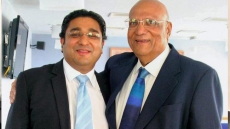
Over four decades after he began his scientific engagement with gravitational science, Professor Abhay Ashtekar is set to receive the prestigious Einstein Prize conferred by the American Physical Society (APS).
The prize for 2018, which carries an award of $10,000, is scheduled to be announced on October 23. Its citation reads: "For numerous and seminal contributions to general relativity, including the theory of black holes, canonical quantum gravity, and quantum cosmology."
Ashtekar is professor of physics, Evan Pugh Professor, Holder, Eberly Chair, and director of the Institute for Gravitation and the Cosmos at the Pennsylvania State University.
"The prize is special because is it the highest honour bestowed by APS in the broad area of gravitational science. The first Einstein prize was awarded jointly to Peter Bergmann and John Wheeler, who introduced general relativity to American universities by creating research groups.
Perhaps because the first award often sets the tone, subsequent prizes have come to recognise ‘lifetime achievements'. So the news was deeply satisfying," Ashtekar told IANS in an email interview.
Ashtekar's passion for physical sciences started while he was in high school in India. "At first I knew only Marathi literature --that is my mother tongue, and was the medium of instruction until I was 11.
Then was exposed Hindi and English literature and realised how deeply literature is tied to specific cultures. What is considered great in one language or context could well be mediocre in another. At the same time, I learned Newton's laws and universality of gravity -- what makes the apple fall on earth also makes the planets go around the sun. This was stunning by itself," he said.
What he found most remarkable was that, unlike art and literature, which are "so tied to human conditions", Newton's laws transcend both. "It was striking to me that the same Newton's laws are taught and admired in India as in China, Japan and the West."
"Later, in college, fundamental physics seemed to me to be the deepest and purest way to pursue understanding of Nature (the external world). In graduate school, I chose to work in general relativity, cosmology and quantum physics because that is where the most fundamental questions about space, time and the nature of the physical universe are discussed," he said.
Somewhere along the line, he also recognised that although one of the main four forces of nature, gravity is the weakest, yet it is so crucial to the way the universe formed and exists.
"Gravity has two key features that other forces do not share. Unlike the weak and strong force, it is long-range and therefore key to the large-scale structures and phenomena. Electromagnetic force is also long-range. But because electric charge comes with both signs, the force can be both attractive and repulsive.
"Large bodies like the sun and planets are all electrically neutral and so they don't exert any electromagnetic force on one another. The dominant force between such bodies is therefore gravitational," he explained.
After receiving his Ph.D. in 1974 from the University of Chicago, Ashtekar went on to hold influential positions in France, Canada and India.
His biography on the National Academy of Sciences, to which he was elected a member in 2016, describes him as someone "best known for initiating the Loop Quantum Gravity programme by introducing new variables to simplify Einstein's equations, for analysing the very early universe using Loop Quantum Cosmology, and for his contributions to the study of the asymptotic structure of space-time and gravitational waves in full non-linear general relativity".
After such a long career in a diversity of physics disciplines, he said science is currently in the "truly golden age for gravity". "Until about the mid-1960s, general relativity had remained isolated from mainstream science -- a pristine and beautiful theory, to be admired from a distance.
"The paradigm has shifted completely and relativistic gravity has moved to centre stage of physics and astronomy. Through the big bang, black holes and gravitational waves, we realised that the universe is not a calm, peaceful place that the astronomers believed it to be in much of the 20th century," he pointed out.
"There are highly energetic explosions sourced by strong gravity that have shaped the history of our universe. Thus, relativistic gravity has completely overhauled our understanding of the cosmos," he said.
"The deepest puzzles in fundamental physics today are at the interface of general relativity and quantum physics. What really happened at the big bang? What is the end point of the quantum evaporation of black holes? How do we incorporate gravity into the unified theories of all fundamental forces? It is clear therefore that gravity will continue to dominate research in physics and astronomy in the coming decades as well," he said.
Asked whether physicists in India are producing world-class research, Ashtekar said: "There are extremely talented physicists in India who are making first-rate contributions to pure physics in areas I have first-hand acquaintance with.
I am particularly pleased by the ‘LIGO-India' project that is now placing India firmly in the front ranks of international efforts. The Inter University Centre for Astronomy and Astrophysics in Pune, in particular, will play an important role in the major discoveries that will be made with the international network of gravitational wave observatories between 5 and 10 years from now. In this area India is ahead of China, for example."
"My colleagues in other areas of physics, on the other hand, tell me that this is not the case in their field; that there is a lot of good research but not enough ‘great' research that gets published in the most visible journals," he said.