Cheers went up, national flags were hoisted and candles lit, but there were some tears too, as India and Bangladesh swapped 162 small enclaves of land in each other's possession at the midnight hour - ending nearly 70 years of statelessness for over 50,000 people residing there.
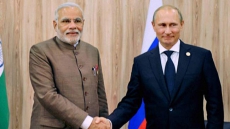
The 111 Indian enclaves in Bangladesh and 51 Bangladeshi enclaves in India were swapped as per the Land Boundary Agreement and the 2011 Protocol, instruments of ratification of which were exchanged during Prime Minister Narendra Modi's visit to Dhaka in May.
For the around 14,000 people living in 51 Bangladeshi enclaves in Indian territory, and the 37,000 residing in 111 Indian enclaves in Bangladesh, they now have a country of their own.
As the clock struck the midnight hour on Friday night, the 51 Bangladeshi land enclaves in Coochbehar district of West Bengal, and the 111 Indian enclaves located in the Bangladesh districts of Lalmonirhat (59), Panchagarh (36), Kurigram 12 and Nilphamari (4) were amalgamated with the main land.
Since partition in 1947, the inhabitants of the enclaves remained where they were - residents of one country but located in pockets in the other.
The small pockets of land had been isolated from the Indian and Bangladeshi mainlands for many decades now, and the people residing there had led a stateless existence - unrecognised by India or Bangladesh.
The ratification and implementation of the 1974 Land Boundary Agreement, and the 2011 protocol has sorted out the land border dispute.
In Mosaldanga enclave of West Bengal's Cooch Behar district, as the clock struck 12, the Bharat Bangladesh Enclave Exchange Co-ordination Committee (BBEECC) that has been fighting for the rights of the enclave dwellers lighted candles and celebrated the occasion.
Sixty-eight candles were lit, marking the years the enclave dwellers have remained stateless. A documentary was also screened highlighting their struggle. National flags were hoisted in the enclaves on both sides of the border.
The people on either side will now get citizenship - and the rights that go along with it. The 51 enclaves in Coochbehar will now get a pin code, the people Aadhar cards and ration cards
On the Bangladesh side, the residents of the enclaves took out processions carrying the red and green flag of Bangladesh, and chanted slogans like: "Noi ar chhit basi, amra ekhon Bangladeshi" (We're no more enclave people, we're Bangladeshis)."
"We are Bangladesh nationals now. I cannot describe in words how happy I am," said 65-year-old Hashem Ali, an inhabitant of Bhitarkuti enclave in Lalmonirhat, the district that had 59 enclaves.
Following Modi's visit in May and the historic LBA ratification, both sides have been busy working out the modalities for exchange. The first step was to ascertain the nationality options of the enclave residents.
The office of the Registrar General of India, Bangladesh Bureau of Statistics and district magistrate, Cooch Behar (India) and deputy commissioners of Lalmonirhat, Panchagarh, Kurigram and Nilphamari (Bangladesh) worked in coordination to collect the options from the residents.
The actual option taking exercise was carried out by 75 teams operating in the enclaves in India and Bangladesh from July 6-16.
Thirty observers from both sides were present in the enclaves during this survey period. Data from this joint exercise is now being verified by the India's registrar general and the Bangladesh Bureau of Statistics, said an official statement.
For the residents, it has meant choosing between staying put in the enclaves and adopting a new nationality, or leaving the homes where their families have lived for generations and moving to the country of their choice.
In some cases, families have been split, with some members choosing to stay put in the enclaves and others moving out to the country of choice.
Around 1,000 of the 37,369 people living in the Indian enclaves in Bangladesh have opted for Indian citizenship, and none of the 14,856 people in the Bangladeshi enclaves in India want to go back to their country.
For those choosing to move to either country, the last date is November 30.
After successfully completing the exercise of ascertaining nationality options, the ground has been prepared for the movement of residents who want to move from an Indian enclave to the Indian mainland.
Both governments are working closely together to facilitate trouble-free movement of these residents before the stipulated date of November 30, said a statement.
"July 31, 2015 will thus be a historic day for both India and Bangladesh. The day marks the resolution of a complex issue that has lingered since independence. It also marks the day from which enclave residents on both sides of the border will enjoy the benefits of nationality of India or Bangladesh, as the case may be, and thus access to civic services, education, healthcare and other facilities provided by the two governments to their respective nationals," said the statement.
Other steps with regard to implementation of the 1974 Land Boundary Agreement and 2011 Protocol are underway in accordance with agreed modalities between the Indian and Bangladeshi governments, it said.