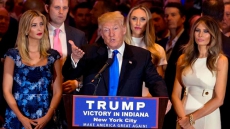
WASHINGTON — A former Donald Trump campaign insider wants to set the record straight on a major story he says the chattering classes missed: It's about Trump's core supporters, who they are, and why they're drawn to him.
It was Matt Braynard's job to identify these supporters. He led Trump's data operation in the early primaries, a position that gave him a unique vantage point into an epochal political phenomenon.
The media misdiagnosed it, he says. They focused on economics, education and race — factors Braynard calls negligible.
Braynard says he spotted something else. As he sifted data and learned to predict with 80 per cent certainty whether someone would prefer Trump to his rivals, he noticed a common worldview. He won't discuss it in detail, but offers hints.
It involves certain types of strength — forceful positions on controversial issues, support for law-and-order at home, and a take-no-prisoners attitude on foreign terrorism.
"The way I like to phrase it is these are people who are rich in the wisdom of the Old Testament. It's a way of looking at the world," Braynard said in an interview.

"At this time of domestic and international turmoil, people want someone who can tell the truth, be strong, and not take (crap) from anyone... Our candidate, effectively, is the law-and-order candidate. And when you've got Black Lives Matter terrorists murdering cops on the street, there's been no better time for a candidate to wear that mantle...
"It cut across all kinds of lines — racial, geographic, income."
Braynard chafes at a one-word label some political science professors have applied to these voters: authoritarian. "It's part of the left's narrative to turn Trump into Hitler. And it is also a smear on Trump supporters."
Braynard ran the data operation from October through the early primaries when he had a falling-out with the campaign. He began by leasing a voter-data package from the company L2, which included material from a firm founded by ex-Obama operatives, HaystaqDNA.
He looked for patterns that identified Trump voters.

He focused on people who'd never voted in a primary; found data that correlated with Trump support (reading Guns&Ammo magazine was one indicator); and contacted likely supporters, instructing them on how to vote in primaries.
"(They'd say), 'You know, I do like that guy.' So we'd say, 'Just make sure you show up and vote.' And that's how we won the nomination."
Not everyone missed the story he's telling. In their version, however, it's less flattering and more ominous. It's told by researchers who study authoritarian voters, a branch of political science that grew from the Second World War.
Matthew MacWilliams of the University of Massachusetts polled 1,800 voters last December and published his findings in a Politico piece titled: "One Weird Trait That Predicts Whether You're a Trump Supporter."
He said respondents who expressed the strongest authoritarian impulses were almost three times likelier to support Trump than those who scored lowest; other Republicans registered no similar spike.
"It only mattered for Trump," MacWilliams said in an interview. "The polling on it couldn't be clearer... People who are disposed to authoritarianism are more likely to be core supporters for Trump."
The Vox website conducted its own poll, finding similar results. Yet a study by Eric Oliver and Wendy Rahn arrived at a different conclusion — that Trump's popularity with authoritarians was lower than Ted Cruz's.

So who are these people?
To identify authoritarians, political science professors use a simple parenting quiz: Would you prefer an independent or respectful child? Curious or well-mannered? Self-reliant or obedient? Considerate or well-behaved? The more one prefers the second trait, the more authoritarian they are likely to be, researchers say.
Top-level authoritarians comprise about 25 per cent of the American electorate, says Jonathan Weiler of the University of North Carolina.
Weiler, the co-author of "Authoritarianism and Polarization in American Politics," says that, historically, these votes were evenly split between U.S. parties. But he found that over the last quarter-century they shifted, coalescing within the Republican party.
Enter Trump, who found an ideal base: "He speaks very well to (them)," Weiler said in an interview.
Authoritarian voters see the world in binary terms, said Weiler and MacWilliams: Order-chaos. Good-evil. Us-them. Black-white, with very little grey.
"Aggression and suspicion of outsiders ... are really two of their key characteristics," Weiler said.
"A person who has that worldview would, for example, want to deal with ... terrorist threats in the most aggressive, militaristic way. And (they're) not just racially resentful, but in general suspicious of, and antagonistic towards, groups they're not familiar with."
There's good news for Trump.
Authoritarians are unwaveringly loyal: "Remember when a Rubio adviser said, in January, 'Trump's support is like granite, there's no way to chip at it?'" said MacWilliams.
"That's because they were authoritarians. They made a decision, and weren't going to change. Remember when Trump said, 'I could go out on Fifth Avenue, shoot someone, and not lose votes?'"

And their numbers can grow. First, non-authoritarians have hopped aboard the Trump train out of loyalty to the Republican party. Then, say Weiler and MacWilliams, chaotic events like terrorist attacks temporarily expand the number of authoritarian-minded voters.
The bad news for Trump?
His other attributes might turn off a part-time authoritarian, Weiler said: "I don't know if Trump projects (steadiness in a crisis). I think Bush projected really solid, steady strength after 9-11... Trump is unhinged."