

Victor Owen Schwartz started a business importing wine and spirits to the United States with his mother nearly 40 years ago. His company VOS Selections, which he runs with his daughter, sells beverages from five different continents alongside American products.
Now he's the lead plaintiff in a court case that could throw a legal roadblock in front of U.S. President Donald Trump's efforts to realign global trade through tariffs.
"I was shocked that those with much more power and money did not step up," Schwartz said Tuesday.
"So when I was afforded the opportunity to speak for small American business, I took it. I had to. It was a moral imperative."
The U.S. Supreme Court is set to hear arguments next week from businesses and states that say Trump's use of a national security statute — the International Emergency Economic Powers Act of 1977 — to hit nearly every nation with tariffs is illegal.
The act, usually referred to by the acronym IEEPA, gives the U.S. president authority to control economic transactions after declaring an emergency. It does not mention the word tariff and the U.S. Constitution reserves power over taxes and tariffs for Congress.
The hearing combines two cases pushing back on Trump's so-called "reciprocal" tariffs and his fentanyl-related duties on Canada, Mexico and China.
The case landed at America's top court after both the United States Court of Appeals for the Federal Circuit and the U.S. Court of International Trade ruled the tariffs exceeded the powers included in IEEPA.
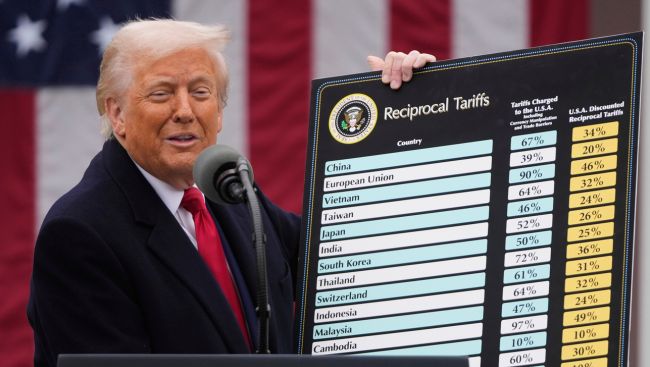
Trump hit the world with his "Liberation Day" duties after declaring an emergency due to persistent U.S. goods trade deficits.
Trump declared fentanyl-related emergencies at the borders to slam Canada and Mexico with economywide duties. Those tariffs do not hit goods compliant with the Canada-U.S.-Mexico Agreement on trade.
The president last week suspended trade talks with Canada and threatened a 10 per cent tariff increase after he was offended by an ad purchased by Ontario's government which used audio of former president Ronald Reagan criticizing tariffs.
"The sole purpose of this FRAUD was Canada's hope that the United States Supreme Court will come to their 'rescue' on Tariffs that they have used for years to hurt the United States," Trump posted on social media Oct. 25.
Trump himself has ramped up pressure on the Supreme Court by repeatedly commenting on the case and what he claims would be the terrible consequences for the U.S. if his administration doesn't win. He even suggested he might attend next week's hearing in person.
Jeffrey Schwab of the Liberty Justice Center, which is representing Schwartz and the other small businesses, said he is not focused on who may be at the hearing.
Schwab said he is confident in their argument that IEEPA does not authorize tariffs. Even if it did, he said, IEEPA is limited to extraordinary threats and emergencies — and a trade deficit doesn't count.
"The president says that he can impose tariffs on any country, at any rate, at any time, for any reason. That essentially means that he's saying IEEPA is a blank cheque," he said. "That can't be what IEEPA means."
If the Supreme Court rules IEEPA doesn't authorize tariffs, both the "reciprocal" and the fentanyl-related duties would be deemed illegal.
But the court could issue a split ruling because the fentanyl-related tariffs are based on a slightly different legal theory, said Stanford Law School professor Michael McConnell.
McConnell, a former judge for the United States Court of Appeals for the Tenth Circuit, said the case is "one for the ages."
"This is a major confrontation between the executive branch and Congress," he said.
The Washington-based Tax Foundation said Tuesday that IEEPA tariffs have increased the applied U.S. tariff rate by more than 13 percentage points and the effective tariff rate by more than seven percentage points.
The foundation said the government has collected more than US$88 billion from the tariffs — fees that are paid by American importers.
Scott Lincicome, vice president of general economics at the Washington-based Cato Institute, said Trump's claim that the court loss would lead to major economic harm is incorrect.
He said invalidating the tariffs would actually benefit the U.S. economy overall because it would eliminate taxes and the massive amount of uncertainty the duties have caused.
Lincicome said IEEPA is essentially putting a "tariff switch in the Oval Office" which makes it impossible for businesses to plan and invest.
Despite what the Trump administration says about other nations shouldering the duties, Schwartz said the tariffs are being paid by American businesses. His New York business is being squeezed by devastating duties Schwartz described as an "existential threat."
He said it's hard to handle the 15 per cent tariff he pays on liquor from the European Union while also keeping prices reasonable for his customers. He's stopped buying anything from South Africa, which was slapped with a 30 per cent duty.
"The tariffs are a terrible and unsustainable weight," he said.
Picture Courtesy: AP Photo/Mark Schiefelbein, File


