

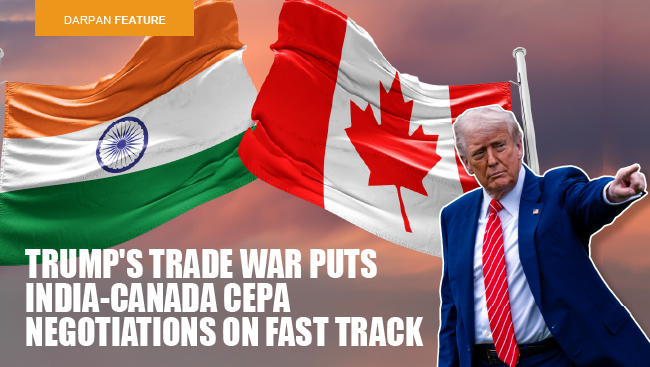
The second term of US President Donald Trump has disrupted the global trade order. At the center of his disruption are at least two big countries - India & Canada. While India has been threatened with 500% tariffs if it does not stop buying Russian oil, Canada faces a huge economic threat due to it being the US’s biggest neighbor & largest trade partner.
Trump’s diatribes on trade & tariffs, however, have opened new doors for greater India-Canada trade. Both countries have been discussing a comprehensive economic partnership since November 23, 2025. With the uncertainty around Trump’s tariffs, India and Canada are looking to hedge their risks by diversifying their trade partners.
This is especially important for Canada, whose economy is highly dependent on the US. A recent Eurasia Group report has warned that Canada’s efforts to diversify trade would face ‘powerful headwinds’. The risk management group also says that the government will have to defend Canadian sovereignty in the wake of the US’s aggressive stance on Latin America & Greenland.
While the US was India’s largest trade partner in FY25 (April 2024-March 2025), with total bilateral trade reaching $131.84 billion, the specter of higher tariffs in the absence of a trade deal could virtually bring bilateral trade to a standstill.
“PM Mark Carney has been clear in mentioning that Canada attaches importance to its relations with the Indo-Pacific and to India. India reciprocates this sentiment and is committed to working closely with Canada to put in place robust institutional mechanisms in all sectors,” says Dinesh Patnaik, India’s High Commissioner to Canada, told DARPAN.
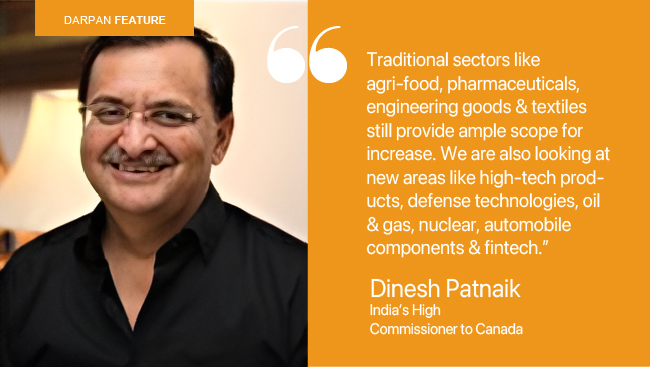
Patnaik’s statement underlines the changing dynamics of the India-Canada bilateral relationship. After a volatile two-year period, during which bilateral ties faced political headwinds, trade and commerce can come to the rescue of both countries.
India and Canada are not big trading partners. In 2024, India was Canada’s seventh-largest goods and services trading partner, with two-way trade standing at $23 billion. However, Canada is not a top trading partner for India, failing to find a spot among the top 10 countries. India also runs a trade deficit with Canada. But a bilateral trade deal could change these figures significantly. In fact, during their recent meeting at the G20 Summit in South Africa, Indian PM Narendra Modi and his Canadian counterpart agreed to double bilateral trade to about $50 billion by 2030.
It's important to note that India holds a key role in Canada's pivot to Asia. As a counterweight to Communist China, a democratic India, with its ambition to become a developed nation by 2047, offers a sizeable economic opportunity to Canada. With India's economy growing rapidly, an energy-rich Canada stands the chance to benefit from India's rising energy demand. This will also help Ottawa diversify away from the US but also secure its energy exports – 30 percent of total exports – from geopolitical fluctuations (read US and China).
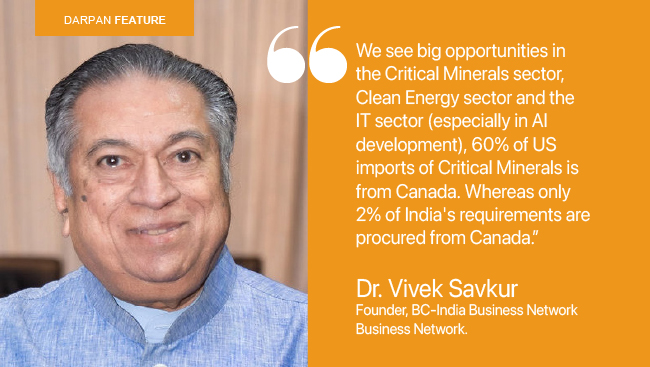
“We see big opportunities in the Critical Minerals sector, Clean Energy sector and the IT sector (especially in Al development),” says Dr Vivek Savkur, Founder of the BC-India Business Network. Dr Savkur notes that critical minerals will be an untapped sector that could prove beneficial to Canada-India bilateral trade. “60% of US imports of Critical Minerals is from Canada. Whereas only 2% of India's requirements are procured from Canada,” he adds.
For the benefit of our readers, Critical Minerals are the foundation upon which modern technology is built. They are used in a wide range of essential products ranging from mobile phones and solar panels to electric vehicle batteries, medical devices, and defense applications.
For India, Canada provides a suitable market for its superior pharmaceutical products, gems & jewelry and smartphones. Moreover, India’s STEM graduates – the world’s largest talent pool – offer Canada vital human resources for futuristic sectors like Artificial Intelligence & quantum computing.
Patnaik is hopeful that a trade agreement will not only boost existing bilateral trade in goods and services but will also add several unexplored dimensions. “Traditional sectors like agri-food, pharmaceuticals, engineering goods & textiles still provide ample scope for increase. We are also looking at new areas like high-tech products, defense technologies, oil & gas, nuclear, automobile components & fintech,” the Indian diplomat says.
The ongoing trade talks are not without their hiccups. Both countries have not been able to seal a deal despite beginning negotiations way back in 2010. A key roadblock had been India's protectionist policies, which made it a difficult export market to penetrate. However, changing geopolitical dynamics and other factors have softened India's trade stance in recent years.
“The challenges that we are likely to face are a turbulent global order which we will need to navigate. There are certain sectors which are critical to both countries, and we will have to try and work around them to create exceptions. The biggest challenge will be the capacity of our negotiators. We will need to make sure that we can put enough time and effort in making these negotiations successful,” says Patnaik, who took charge as the Indian envoy to Canada in August 2025.
Dr Savkur, on the other hand, does not see political issues hindering a possible trade deal between India and Canada. Although he notes that previous negotiations could not resolve many grey areas relating to tariffs and import duties, he believes that the present situation involving Trump's uncertain trade policies can actually aid in concluding a trade deal.


