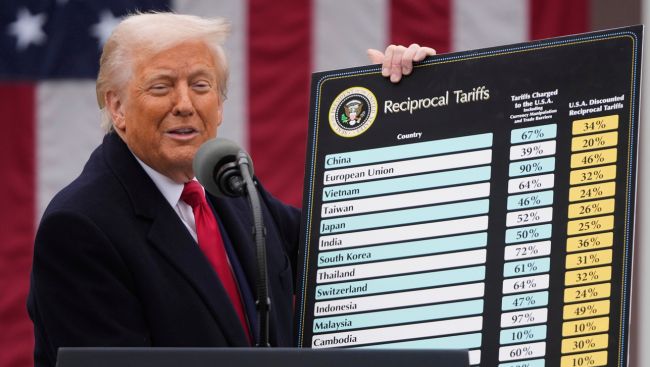
The U.S. Supreme Court on Friday struck down President Donald Trump's use of a national security statute to deploy tariffs, reining in his efforts to realign global trade — but the decision doesn't end all the U.S. duties slamming Canadian industries.
In a 6-3 ruling, the court concluded it was not legal for Trump to use the International Emergency Economic Powers Act, better known as IEEPA, for his "Liberation Day" tariffs and fentanyl-related duties on Canada, Mexico and China.
"The United States Supreme Court’s decision reinforces Canada's position that the IEEPA tariffs imposed by the United States are unjustified," Canada-U.S. Trade Minister Dominic LeBlanc said in a post on social media.
"While Canada has the best trade deal with the United States of any trading partner, we recognize that critical work lies ahead to support Canadian businesses and workers who remain affected by Section 232 tariffs on steel, aluminum and automotive sectors."
Trump has warned repeatedly that if the court ruled against his tariff agenda, it would lead to catastrophic consequences for national security, foreign policy and the economy.
Justices on the conservative-led Supreme Court appeared skeptical of that argument during a three-hour November hearing, however. Several of them noted IEEPA does not mention tariffs.
Presidents have used IEEPA many times for things like sanctions, but Trump is the first to use it for tariffs.
Friday's majority decision found that the U.S. Constitution "very clearly" gives Congress power over taxes and tariffs.
"The Framers did not vest any part of the taxing power in the Executive Branch," Chief Justice John Roberts wrote.
It did not address whether the companies hammered by those tariffs should get refunds.
George Mason University law professor Ilya Somin, who represented small businesses pushing back on the tariffs, said it's clear IEEPA does not allow the president to impose tariffs on any country or product at any rate, for any amount of time.
"It's a major victory for the constitutional separation of powers, for free trade, and for the millions of American consumers and businesses enduring the higher taxes and higher prices as a result of these tariffs," Somin, who is also chair in constitutional studies at the Cato Institute, said in a media statement.
The decision does not affect Trump's use of other tools to hit Canadian steel, aluminum, automobiles, lumber and other industries with separate duties.
Trump declared an emergency at the northern border related to the flow of deadly fentanyl in order to use IEEPA to hit Canada with 35 per cent tariffs. Those duties do not apply to goods compliant under the Canada-U.S.-Mexico Agreement on trade, known as CUSMA.
U.S. government data shows a minuscule amount of fentanyl is seized at the border with Canada. Last week, in a symbolic move, the U.S. House of Representatives voted to end the emergency at the northern border.
Trump's tariffs and threats of annexation have rattled Canada ahead of a mandatory review of the CUSMA trilateral trade pact later this year.
Canadian Chamber of Commerce president and CEO Candace Laing said the Supreme Court's ruling is not a reset of U.S. trade policy and "not the last chapter of this never-ending story."
"Canada should prepare for new, blunter mechanisms to be used to reassert trade pressure, potentially with broader and more disruptive effects," Laing said in a media statement.
Picture Courtesy: AP Photo/Mark Schiefelbein, File