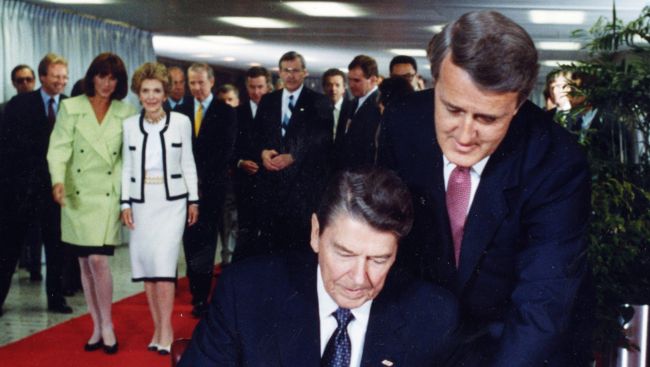
The latest storm in Canada's tense trade negotiations with the United States erupted over an Ontario government advertising campaign that pushes back on tariffs by using snippets of former U.S. president Ronald Reagan's comments on the issue decades ago.
U.S. President Donald Trump said late Thursday that he is terminating trade negotiations with Canada because of the campaign, calling it a "fraud" that misrepresents Reagan's stance on tariffs.
Here are the transcripts of Ontario's anti-tariff ad aimed at Republican voters in the U.S., and the full radio address Reagan delivered to Americans on April 25, 1987.
---
CLIPS FROM REAGAN'S ADDRESS USED IN THE AD
When someone says, "Let's impose tariffs on foreign imports," it looks like they're doing the patriotic thing by protecting American products and jobs. And sometimes for a short while it works – but only for a short time.
But over the long run, such trade barriers hurt every American worker and consumer.
High tariffs inevitably lead to retaliation by foreign countries and the triggering of fierce trade wars.
Then the worst happens. Markets shrink and collapse. Businesses and industry shut down, and millions of people lose their jobs.
Throughout the world, there's a growing realization that the way to prosperity for all nations is rejecting protectionist legislation and promoting fair and free competition.
America's jobs and growth are at stake.
---
REAGAN'S FULL ADDRESS
My fellow Americans:
Prime Minister Nakasone of Japan will be visiting me here at the White House next week. It's an important visit, because while I expect to take up our relations with our good friend Japan, which overall remain excellent, recent disagreements between our two countries on the issue of trade will also be high on our agenda.
As perhaps you've heard, last week I placed new duties on some Japanese products in response to Japan's inability to enforce their trade agreement with us on electronic devices called semiconductors. Now, imposing such tariffs or trade barriers and restrictions of any kind are steps that I am loath to take. And in a moment I'll mention the sound economic reasons for this: that over the long run such trade barriers hurt every American worker and consumer. But the Japanese semiconductors were a special case. We had clear evidence that Japanese companies were engaging in unfair trade practices that violated an agreement between Japan and the United States. We expect our trading partners to live up to their agreements. As I've often said: Our commitment to free trade is also a commitment to fair trade.
But you know, in imposing these tariffs we were just trying to deal with a particular problem, not begin a trade war. So, next week I'll be giving Prime Minister Nakasone this same message: We want to continue to work co-operatively on trade problems and want very much to lift these trade restrictions as soon as evidence permits. We want to do this, because we feel both Japan and the United States have an obligation to promote the prosperity and economic development that only free trade can bring.
Now, that message of free trade is one I conveyed to Canada's leaders a few weeks ago, and it was warmly received there. Indeed, throughout the world there's a growing realization that the way to prosperity for all nations is rejecting protectionist legislation and promoting fair and free competition. Now, there are sound historical reasons for this. For those of us who lived through the Great Depression, the memory of the suffering it caused is deep and searing. And today many economic analysts and historians argue that high tariff legislation passed back in that period called the Smoot-Hawley tariff greatly deepened the depression and prevented economic recovery.
You see, at first, when someone says, "Let's impose tariffs on foreign imports,'' it looks like they're doing the patriotic thing by protecting American products and jobs. And sometimes for a short while it works – but only for a short time. What eventually occurs is: First, homegrown industries start relying on government protection in the form of high tariffs. They stop competing and stop making the innovative management and technological changes they need to succeed in world markets. And then, while all this is going on, something even worse occurs. High tariffs inevitably lead to retaliation by foreign countries and the triggering of fierce trade wars. The result is more and more tariffs, higher and higher trade barriers, and less and less competition. So, soon, because of the prices made artificially high by tariffs that subsidize inefficiency and poor management, people stop buying. Then the worst happens: Markets shrink and collapse; businesses and industries shut down; and millions of people lose their jobs.
The memory of all this occurring back in the '30s made me determined when I came to Washington to spare the American people the protectionist legislation that destroys prosperity. Now, it hasn't always been easy. There are those in this Congress, just as there were back in the '30s, who want to go for the quick political advantage, who will risk America's prosperity for the sake of a short-term appeal to some special interest group, who forget that more than 5 million American jobs are directly tied to the foreign export business and additional millions are tied to imports. Well, I've never forgotten those jobs. And on trade issues, by and large, we've done well. In certain select cases, like the Japanese semiconductors, we've taken steps to stop unfair practices against American products, but we've still maintained our basic, long-term commitment to free trade and economic growth.
So, with my meeting with Prime Minister Nakasone and the Venice economic summit coming up, it's terribly important not to restrict a President's options in such trade dealings with foreign governments. Unfortunately, some in the Congress are trying to do exactly that. I'll keep you informed on this dangerous legislation, because it's just another form of protectionism and I may need your help to stop it. Remember, America's jobs and growth are at stake.
Until next week, thanks for listening, and God bless you.
Picture Courtesy: CP PICTURE ARCHIVE - Blaise Edwards