The impact of the massive spending bill President Donald Trump signed into law on Independence Day is expected to filter down to infants and toddlers — a segment of the population that's particularly vulnerable to cuts to the federal social safety net.
Many middle-class and wealthy families will see benefits from the legislation, but programs that help low-income families keep babies healthy have been cut back. While state money funds public schools and preschool in some cases, programs supporting the youngest children are largely backed by the federal government.
The law extends tax cuts Trump passed during his first term and pours billions more dollars into border security as he seeks to broaden his crackdown on immigration. To pay for these initiatives, the law cuts Medicaid and food stamps — programs relied upon by poor households with children — by more than $1 trillion.
The legislation Republicans called Trump's “big beautiful bill" is set to deliver some gains for families with children. It increases tax credits, including one that now allows parents to deduct up to $2,200 per child from their tax bills. And it introduces investment accounts for newborns dubbed “Trump Accounts,” each seeded with $1,000 from the government.
Still, advocates say they don't make up for what children are likely to lose under the law. And they fear what comes next, as the next Trump budget proposes more cuts to programs that help parents and babies.
Medicaid cuts could add to strains on families
More than 10 million Americans rely on Medicaid for health care. About 40% of births are covered by Medicaid. Newborns, too, qualify for it when their mothers have it.
The new law doesn't take little kids or their parents off Medicaid. It institutes Medicaid work requirements for childless adults and adults with children over the age of 13. But pediatricians warn the cuts will be felt broadly, even by those who don't use Medicaid.
The Medicaid cuts are expected to put a financial strain on health care providers, forcing them to cut their least profitable services. That’s often pediatrics, where young patients are more likely to use Medicaid, said Lisa Costello, a West Virginia pediatrician who chairs the federal policy committee for the American Association of Pediatrics.
The ripple effects could exacerbate an existing shortage of pediatricians and hospital beds for children.
“Any cuts to that program are going to trickle down and impact children, whether that’s pediatric practices who depend on Medicaid to be able to stay open or children’s hospitals,” Costello said.
States also use Medicaid to pay for programs that go beyond conventional medical care, including therapies for young children with disabilities. Under the law, states will foot a greater portion of the bill for Medicaid, meaning optional programs are at risk of getting cut.
While parents of young children are exempt from the work requirement, recipients must verify they're in compliance or exempt from the requirement every six months. Critics fear eligible adults will lose their coverage because of the new reporting requirements.
If an adult loses Medicaid coverage, it could ratchet up household stress and make it more difficult for parents to make ends meet, both of which can negatively impact youngsters. And parents who lose their health insurance are less likely to take their children to the doctor.
“When parents lose their health insurance, they often think that their children also are no longer eligible, even if that’s not the case,” said Cynthia Osborne, a professor of early education and the executive director of the Prenatal-to-3 Policy Impact Center at Vanderbilt University.
The law increases tax credits for parents who qualify
The law increases the child tax credit to $2,200 per child, up from $2,000. But parents who don’t earn enough to pay income tax will still not see the benefit, and many will see only a partial benefit.
The measure also contains two provisions intended to help families pay for child care, which in many places costs more than a mortgage. First, it boosts the tax credit parents receive for spending money on child care. It also expands a program that gives companies tax credits for providing child care for their employees.
Both measures have faced criticism for generally benefiting larger companies and wealthier households.
“It’s a corporate business tax break,” said Bruce Lesley, president of the advocacy group First Focus on Children. “It makes their child care dependent upon working for an employer who has the credit.”
‘Trump Accounts’ will be opened with $1,000 for newborns
The law launches a program that creates investment accounts for newborns. The “Trump Accounts” are to be seeded with $1,000 from the government, and children will be able to use the money when they become adults to start a new business, put the money toward a house or go to school.
Unlike other baby bond programs, which generally target disadvantaged groups, the federal program will be available to families of all incomes.
The program's backers have pitched the accounts as a way to give young people a boost as they reach adulthood and teach them about the benefits of investing. Critics argue families in poverty have more immediate needs and their children should receive a larger endowment if the goal is to help level the playing field.
A food assistance program faces cuts
The Supplemental Nutrition Assistance Program faces the largest cut in its history under the law. It will, for the first time, require parents to work to qualify for the benefit if their children are 14 or older. But even households with younger children could feel the impact.
The law kicks some immigrants — including those with legal status — off food assistance. It makes it more difficult for individuals to qualify by changing how it considers their utility bills.
SNAP has historically been funded by the federal government, but under the new law, states will have to shoulder some of the financial burden.
Cash-strapped governments could decide to implement new requirements that would make it more difficult for people to qualify, said Katie Bergh, a senior policy analyst with the Center on Budget and Policy Priorities. Some states may decide to exit the program altogether.
“This bill fundamentally walks away from a long-standing nationwide commitment to making sure that low-income children in every state can receive the food assistance that they need," Bergh said.
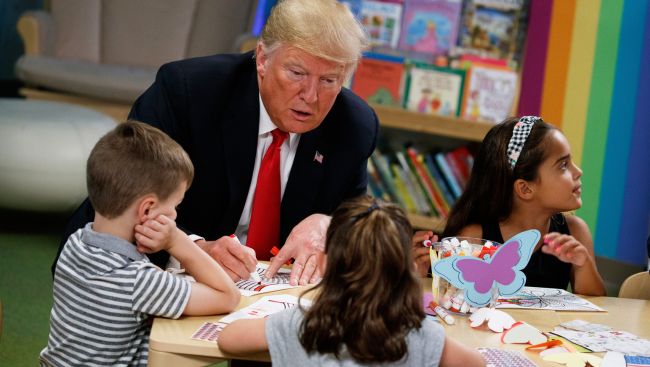
Picture Courtesy: AP Photo/Evan Vucci, File