WASHINGTON - Why is President Barack Obama so hesitant to talk about Islamic extremism — the question is being raised repeatedly these days by many of his Republican opponents who accuse him of chronic political correctness or, worse, of softness on terrorism.
But a sympathetic answer in support of the president came Sunday from a slightly surprising place: the former chief speechwriter of ex-president George W. Bush.
The scribe who held the pen in the post-9-11 years during Bush's war on terror explained why he thinks the current president is right to tone down the talk about Islam.
And Michael Gerson didn't flinch when asked whether Obama and Bush had a similar approach. When it comes to talking about Islam, he said, they're indistinguishable.
"You are right," Gerson replied during a segment on NBC's Meet the Press. "There is a remarkable consistency between the previous administration and this one. And for a certain reason."
The reason, he said, is that the fight against ISIL must be seen as a fight of free people against violent extremists, not as a clash of religions and civilizations.
He said the latter is precisely the fight ISIL wants. And he said it would keep crucial Muslim allies from siding with the West in the fight against the terror group.
That's one reason Bush and Obama have avoided references to radical Islam, and the next president will too, he predicted: "Any future president will do this, I promise. You need Muslim allies in the war on terror. You can't alienate them. The Jordanians, the Turks, or others — these are important allies, and your language matters."
He illustrated his point by offering examples of the "Bush/Obama approach" in a piece in the Washington Post.
He included snippets of Bush speeches from the 2000s that could just as easily have been delivered by Obama. After 9-11, Bush said: "The face of terror is not the true faith of Islam." Years later, he noted, Bush said it was radicals spreading the word that the current conflicts were about America against Islam and added: "I believe that Islam is a great religion that preaches peace."
Gerson asked critics how they'd expect to blast Islam, and then hope to retain the military support of the King of Jordan, who claims to be a 43rd-generation descendant of the Prophet Muhammad. "Some of the president's critics," he said, "are blithely recommending a massive, unforced geostrategic blunder."
The current White House avoids putting the anti-terrorism struggle in religious terms, other than to speak of terrorists as people with a warped interpretation of Islam.
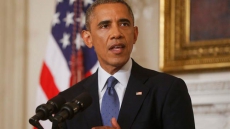
This week Obama laid out his rationale. He told an anti-extremism conference that it's an "ugly lie," and a counter-productive one, to feed the idea that the West is at war with Islam. He said terrorists can't be allowed any legitimacy as religious defenders: "They're not religious leaders, they're terrorists."
But several members of his Republican party are decidedly more aggressive in talking about Islam. And they've called out the president for his verbal mildness.
The most attention-grabbing response this week came from former New York mayor Rudy Giuliani, who looked at Obama's criticisms of the U.S. and reluctance to criticize Islam and offered his conclusion that the president doesn't love America.
In Canada, the Harper government may be much more aggressive than the Obama administration in raising the threat of terrorism but, when speaking about Islam itself, the differences are subtler. The Harper government casts the current anti-terror struggle as a fight against violent "jihadists."
A Canadian cabinet minister attending an anti-radicalization summit last week in Washington cast the differences between the governments as rhetorical, not substantive.
"There could be nuances in the delivery," Public Safety Minister Steven Blaney said in an interview.
"But on the substance we are — as President Obama said (at the conference) — we're all in the same boat."