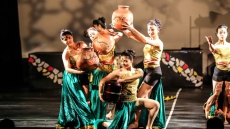
The strikingly exuberant colours, decorations and signs come together to create a meaningful sea of celebration infused with tradition, culture and community.
The celebrations of Vaisakhi are undoubtedly a visual feast. The strikingly exuberant colours, decorations and signs come together to create a meaningful sea of celebration infused with tradition, culture and community. The procession of Vaisakhi, celebrating the birth of Khalsa community, is led by the Guru Granth Sahib Ji, considered a living Guru. In fact, the chaur sahib, constructed from yak hair mounted on a wooden handle, is waved upon the Guru as a sign of respect and humility. The parade is led by the Pang Pyaare, representing the ‘five beloved ones’ that were initiated into the Khalsa.

One of the most prominent colours of Vaisakhi is saffron, or kesari. This shade of orange signifies courage, wisdom and deep bliss, often associated with sentiments of martyrdom as well. The kesari colour can usually be seen on the Nishan Sahib, which is the Sikh flag symbolizing freedom; ‘nishan’ means stamp while sahib is added for respect. The flag can be found at all Sikh temples, or ‘Gurdwaras’, which literally translates to “door of the Guru,” illustrating that people from all faiths are welcome. This also relates to the selfless service principle, seva, the driving force behind the many free services, food and activities implemented during Vaisakhi celebrations.

Navy blue, another popular colour, represents sensitivity and intuition, alongside signifying war and service as it has traditionally been worn by Nihang Sikh warriors, especially as part of their turban; turbans are a symbol of identity, equality and preservation of the hair. Another article of clothing, the free-flowing, unisex chola, adorned by various gear-like additions, traces back to the freedom of movement for an always-ready warrior. This may be worn by those participating in Gatka, the Sikh martial arts – or by any person attending celebrations.
Gold, the colour of Sri Harminder Sahib, commonly known as the Golden Temple, can also be a representation of happiness and healing. As a colour that is often related to feeling grounded, black may come up, during Vaisakhi, as a depiction of resentment or protest against communal or political wrongs. On the other end, white denotes purity and peace, containing within it the entire colour spectrum. Although these colours encompass special meanings, the holistic belief is that all colours are equal.

Besides colours, a widespread symbol you may see is the khanda, made up of three distinct parts. The khanda itself, a double-edged sword is a portrayal of one God. This meaning also coincides with that of Ik Onkar, made up of the number ‘one’ and Punjabi alphabet, ‘urha’, meaning God. Secondly, the chakar is the round center; it indicates that God is without beginning or end, much like the Kara you may see on the wrists of many. Finally, the two kirpans on the side are a symbolization of righteousness, spiritual power and defense of the weak.
With unique embodiments, each of these symbols bring with them a distinct purpose, history or meaning that is weaved into the fabric of Vaisakhi. As you soak in the celebration delights, embrace the ‘why’ behind what you see. As life long learners, it is always good to ask about what you’d like to know more about and educate others about what you do know.