

This past year was the third warmest on record and stood on the cusp of surpassing a major climate threshold globally, according to new data from the European climate agency.
The Copernicus data indicates 2025 was about 1.47 degrees warmer than pre-industrial levels, following the previous year's record-setting 1.6 degrees. When 2023 is added to the mix, it's the first three-year period on record to exceed 1.5 degrees, the data suggests.
At the current rate, the 2015 Paris Agreement's long-term global warming limit of 1.5 degrees could be reached by the end of this decade, about a decade earlier than predicted when the climate pact was signed, the agency said in a press release.
Canada is warming even faster than the global average. The loss of snow and sea ice – reflective shields against the sun – is leaving more of the country's vast northern lands and seas exposed, which in turn drives up temperatures.
Here are five other numbers that help to illustrate how climate change, driven by the burning of fossil fuels, is reshaping life in Canada and for Canadians.
MORE THAN 89,000 SQUARE KILOMETRES OF FOREST BURNED
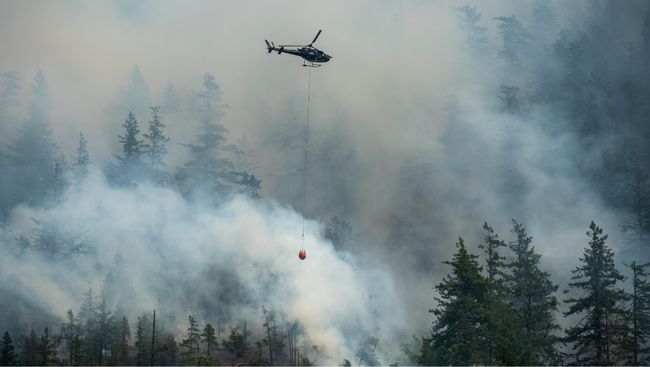
Canada endured its second worst wildfire season on record in 2025, behind only the 2023 season and marking a third consecutive active fire season. Preliminary results suggest fires consumed an area about the size of mainland Portugal, or 89,221 square kilometres.
Canada spent much of this wildfire season at its highest alert level. Thousands of people had to flee their homes and international firefighters were flown in to help.
The area burned by wildfire in the past decade is more than three times larger than what it was in the early 1970s, in large part due to human-caused climate change, said Mike Flannigan, one of Canada's foremost wildfire experts.
"A colleague of mine wrote a paper in the '90s saying urgent action is needed now to deal with climate change. And here it is 25, 30 years later saying the same bloody thing – urgent action is needed now and it's falling mostly on deaf ears," said Flannigan, a professor of wildland fire at Thompson Rivers University in Kamloops, B.C.
Warming temperatures are key to worsening forest fires for several reasons, said Flannigan. As temperature increase, the season gets longer, lightning strikes are expected to become more frequent and the forest's vegetation gets drier.
$9.2 BILLION IN ESTIMATED CATASTROPHIC LOSSES
Along with wildfires, warmer temperatures are helping to fuel more powerful and less predictable storms. Those storms are costing Canadians in ways that include hail-damaged cars, flooded homes and downed power lines.
The Institute for Catastrophic Loss Reduction estimates Canada now suffers an average of about $9.2 billion in annual losses from catastrophes, defined as events resulting in at least $30 million in insured losses. The estimates also account for uninsured losses. Many, but not all, of those losses are incurred during wildfires or periods of extreme weather, including floods and hail.
The research institute, a non-profit backed by the insurance industry and affiliated with Western University, says that when adjusted for inflation, the losses have grown by about 9.3 per cent annually since the early 1980s, far outpacing population, GDP and construction spending -- all contributing factors to the rise.
"While I caution that you can't attribute that solely to climate change, there are other factors as well, but climate change is playing quite a big role in those losses," said Glenn McGillivray, the institute's managing director.
"Climate change just kind of loads the dice a little bit and makes these things a bit more probable, a bit more common and, when they happen, even worse."
In less than a month in 2024, Canada recorded four of its top 10 costliest events: the Calgary hailstorm, remnants of Hurricane Debby, the Jasper wildfire and southern Ontario flooding.
Those events, and others like them, have contributed to the surging price tag Canadians pay for home insurance.
Home insurance in hard-hit areas of British Columbia have seen premiums rise by almost 68 per cent from 2021 to 2025, according to a recent report by TD Economics, with increases in similarly hard-hit parts of Alberta and Prince Edward Island also topping 50 per cent.
3 MONTREAL HEAT WAVE DEATHS
As temperatures rise, so too does the number of days where Canadians are exposed to extreme heat.
Dr. Samantha Green, a Toronto family physician, says that can be dangerous, especially for vulnerable groups from isolated seniors to outdoor workers. Extended stretches of extreme heat, especially when nighttime temperatures don't cool down, can worsen chronic conditions such as diseases affecting the heart, lung and kidneys, she said.
"We need to figure out how best to protect the most vulnerable in our communities because this is a growing threat,' said Green, president of the Canadian Association of Physicians for the Environment.
Montreal's public health department says during a heat wave from Aug. 10 to 13 last year, it received three reports of deaths that may have been heat-related. That same heat wave over southern Quebec was found to be at least two to 10 times more likely due to climate change, according to a rapid analysis by federal government scientists.
In Toronto, there were six heat warnings issued between June and August. During those periods, there were a total of 74 heat-related emergency department visits, Toronto Public Health said.
Both cities could, by around mid-century, see at least 20 more days where temperatures top 30 degrees compared to what was typical at the end of the 20th century, climate models suggest.
920,000 SQUARE KILOMETRES OF SUMMER SEA ICE
It was a record year, at least at times, for declining sea ice across both poles, Copernicus data shows.
In February, the combined sea ice cover from both poles was the lowest it's been since satellite observations started in the late 1970s. In the Arctic, monthly sea ice extent was the lowest on record for January, February, March and December, and the second lowest in June and October.
Environment and Climate Change Canada says summer sea ice cover across Canada's northern waters has declined by about seven per cent each decade since the late 1960s, when its records began.
In 2025, the department says summer sea ice was down to 920,000 square kilometres – not as bad as the worst years, but still at a level virtually unseen until the past 20 years. Studies suggest the Arctic Ocean could become virtually ice-free by mid-century, and possibly even sooner, largely due to planet-warming emissions.
27.8 PER CENT INCREASE IN COFFEE PRICES
To food economist Mike von Massow, coffee prices are a "canary in the coal mine" of climate change. The crop is facing serious threats from rising temperatures, unpredictable rainfall and increased disease.
Von Massow says those climate-related impacts are a big driver of the rising costs here in Canada. Coffee prices were 27.8 per cent more in November 2025 compared to a year earlier, according to Statistics Canada data, continuing a longer-standing upward trend.
While U.S. tariffs on coffee likely helped drive up prices too, "the long-term increase in these prices is due to both warming temperatures and increasing variability in weather," said von Massow, a professor at the University of Guelph.
When grocery prices go up, they can often be traced back to conditions in the fields made worse by climate change, von Massow said.
Surging lettuce prices in late 2025 were likely influenced by extreme weather and disease issues in Southern California, where Canada gets much of its supply that time of year, he said. He also pointed to how drought conditions have pushed up beef prices as farmers struggle to keep up their herds and afford feed costs.
Picture Courtesy: THE CANADIAN PRESS/Tijana Martin


