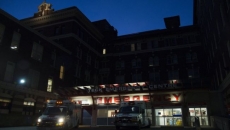
The fast-moving Jasper, Alta., wildfire was fuelled by a web of extreme conditions that converged into what experts described as a monstrous fire, serving as a disastrous example of what's become increasingly common across Canada's boreal forest.
What has happened in Jasper National Park is a "microcosm of what we're seeing across Western Canada," said wildfire risk expert and former Parks Canada wildland firefighter Mathieu Bourbonnais.
More than 20,000 people in and around the Rocky Mountain townsite were ordered to evacuate last Monday. By Wednesday night, fires had reached Jasper, with flames and smoke so intense it forced first responders to briefly retreat. About 30 per cent of the townsite has been destroyed.
Questions and accusations have followed, including from critics who argue Parks Canada and other government agencies did not do enough to protect Jasper.
The reality, says wildfire expert Chris Stockdale, is that the fire eludes simple explanations.
“I think the compelling story is that it’s complex,” said Stockdale, a wildfire risk management expert at Canada's Northern Forestry Centre in Edmonton.
Here is how wildfire experts described the blaze, how some well-publicized critiques oversimplify the problem, and how Canada's forest-managing and firefighting agencies may better prepare.
What were some of the major drivers of the Jasper wildfire?
Wildfire expert Mike Flannigan says the major drivers of the fire were a confluence of several extreme conditions. Drought in Western Canada combined with a roughly three-week stretch of hot temperatures to dry out the vegetation in the forest.
Lightning strikes on Monday night are thought to have lit the sparks that combined with strong winds to fan the flames across a dried-out landscape primed for a major fire, said Flannigan, a professor of wildland fire at Thompson Rivers University.
The wildfires, which Flannigan said "love to run up and down river valleys," started to the northeast and south of the Jasper townsite, itself located in a high-risk area at the confluence of three river valleys. Within 48 hours, fire was destroying homes and other buildings.
"It's like a nightmare coming towards you," said Flannigan.
Officials say flames licked the sky as high as 100 metres above the forest's canopy, catapulting scorched pine cones and other embers well ahead of the fire, accelerating its pace toward the townsite.
Overhead, a hellish storm formed, entirely of the fire's making. The fire-induced thunderstorm, called a pyrocumulonimbus storm, can generate lightning strikes and downdrafts, further igniting and fuelling the fires.
"It's basically a moving monster," Stockdale said.
The extreme conditions underlying the wildfire are "consistent with what we expect with climate change," Flannigan said.
Lightning strikes are expected to become more frequent as the planet warms. A warmer atmosphere, meanwhile, can absorb more moisture, helping to further dry out the vegetation that fuels the fire.
"A warmer world means more fire," he said.
What about the mountain pine beetle infestations?
Parks Canada has faced questions about whether it properly managed the swaths of dead forest that had been infested in recent years by mountain pine beetle, a wood-boring insect.
The pine beetle infestation, which peaked in 2019 before a major cold snap helped wipe out most of the population, has left behind dead pines across millions of hectares in Western Canada, including Jasper.
Those dead pine trees helped fuel the Jasper fire, but Stockdale, Bourbonnais and Flannigan all agreed it was likely not a major driver in comparison to the extreme fire conditions, such as drought and prolonged high temperatures.
“The pine beetle isn’t what made that fire so uncontrollable. It made it even more uncontrollable, but it’s not like pine needle put it over the threshold where it suddenly became an unmanageable fire," said Stockdale.
Pine beetle has infested roughly 21 million hectares of Canada's forests, Stockdale said. Removing all the beetle-infested wood from a fire-safe radius around each nearby Canadian town would be a monumental task.
"It oversimplifies the problem," he said.
“When you look at an individual community, it’s easy to say, ‘if they’d only done this, if they’d only done that, if someone had done this, this wouldn’t happened.’ Sure, but it’s not the only community, there’s hundreds of them. And there’s finite resources."
Some commentators have also elevated the infestation to explain the fire's intensity, while simultaneously downplaying the role of climate change.
That argument overlooks that the infestation itself has been propelled by a warming planet, Bourbonnais said. Fewer cold snaps help the pine beetles grow their populations, while warmer conditions have also helped them expand into new areas, with Jasper residing on the edge of their historic and newly expanded range.
"Its life cycle is really closely tied to climate," said Bourbonnais, assistant professor at the University of British Columbia's Okanagan campus and co-director of the university's Centre for Wildfire Coexistence.
Are Canada's wildfire-fighting agencies doing enough prescribed burns?
Wildfires are a natural part of the boreal ecosystem, helping regenerate the forest in decades-long cycles. Logs and leaves are turned into mineral-rich ash that gets recycled into the soil on the forest floor, which is better exposed to sunlight that can stimulate new growth from seeds and roots.
Indigenous peoples, who were forcibly driven out of what's now known as Jasper in the early 20th century, had a long history of prescribed burns, which also helps reduce the risk of an out-of-control blaze.
But for many decades, provincial and federal agencies have suppressed fires across Canada's forests. In Jasper, landscapes once featuring grasslands and meadows with healthy elk and bison populations have been overtaken by stands of dense pine trees more susceptible to fire.
"So, you have these even-aged homogeneous landscapes out there of single species. Then you get a fire into that under the right conditions and there's really nothing to stop it naturally," said Bourbonnais.
Parks Canada eventually reintroduced prescribed burns starting in the 1980s, expanding it to Jasper in 1996, but the scale and frequency of those burns have not made up for years of suppression, a 2022 federal report said.
Despite the shortcomings, Parks Canada has become one of the most active agencies in Canada for prescribed burns, said Bourbonnais.
Yet, taken as a whole, agencies across the country burn less than one per cent of land in prescribed fires compared to their counterparts in the United States, despite overseeing more forest, he said.
"We have to start turning that tide I think really, really soon," said Bourbonnais, who's an ex-member of Alberta's disbanded Wildfire Rappel Program.
Is it time for a centralized emergency-management agency?
Wildfire experts say more resources need to be spent on fire mitigation and prevention measures across Canada, including for prescribed burns.
Budgets for wildfire fighting have paled in comparison to the resources spent on preventing mega-fires that have consumed the country's forests in recent years, Bourbonnais said.
Governments should also craft better legislation around how forests are harvested by the logging industry, setting out how those areas get replanted to promote more fire-resilient landscapes, he said.
Flannigan, meanwhile, has advocated for the federal government to establish a national agency comparable to the Federal Emergency Management Agency in the United States. He envisions the agency would be the point of command during disasters, including hurricanes and floods, and staffed with well-trained, quick deploy wildland firefighters.
"Whether it’s reactionary or proactive, this is something we should consider. Not having a FEMA-type agency, it just seems weird that we don’t," he said.
Asked recently about the possibility of establishing such an agency, Canada's Emergency Preparedness Minister Harjit Sajjan said it was being explored. But he praised the preparedness in Jasper and said all requests for more wildfire support had been approved.
More broadly, Bourbonnais said the fires should also serve as a chance to rethink a relationship with the landscape that has helped foster a fire-primed forest and fire-prone communities.
"Focusing in on one thing, like, 'what does this community have to do?' Or, 'what did they do wrong?' That's not the point. This is going to continue happening unless we change something," he said.
"We do have a lot of the tools to start changing the outcome. We're just not applying them at the scale we need."